



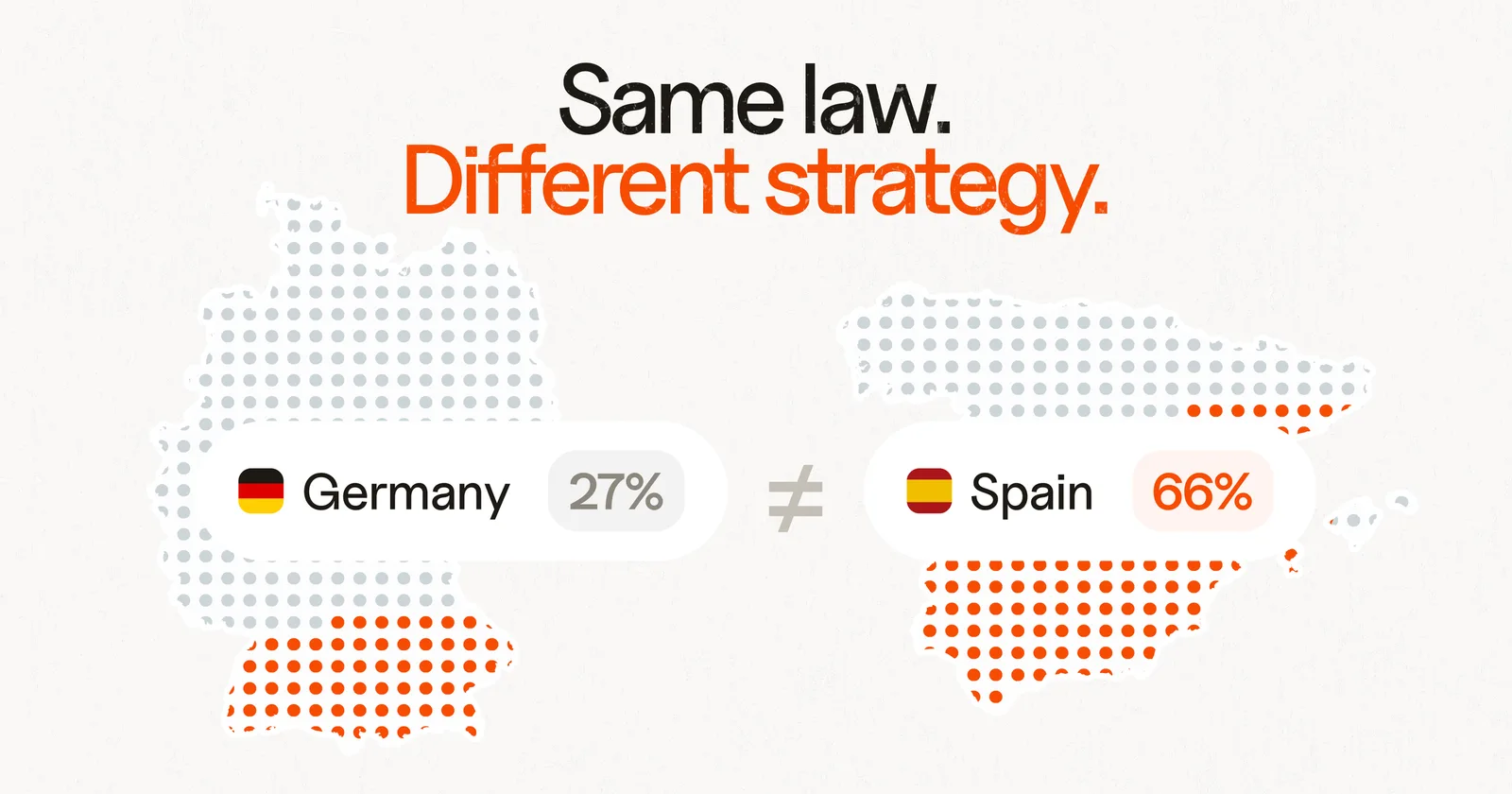
Two out of three large Spanish online shops send data to Google Ads before the visitor has answered the cookie banner. In Germany it is about one in four. The law is essentially the same in both countries, and visitors accept cookies at almost the same rate. What differs is how the shops set up Google Consent Mode.
We know this because we tested it. In November 2026 we loaded the homepages of 400 large online shops, 200 in Germany and 200 in Spain, in a test browser. We recorded what each shop sends to Google, Meta and TikTok at three moments: before any cookie choice, after “accept all” and after “reject all”. 327 shops could be measured.
This article shows the numbers, explains what Basic and Advanced Consent Mode mean for your ad measurement, and ends with a seven-point check for your own shop.
TL;DR
- Before the cookie choice: 66% of Spanish shops and 27% of German shops already send data to Google Ads, almost all of them without cookies through Advanced Consent Mode.
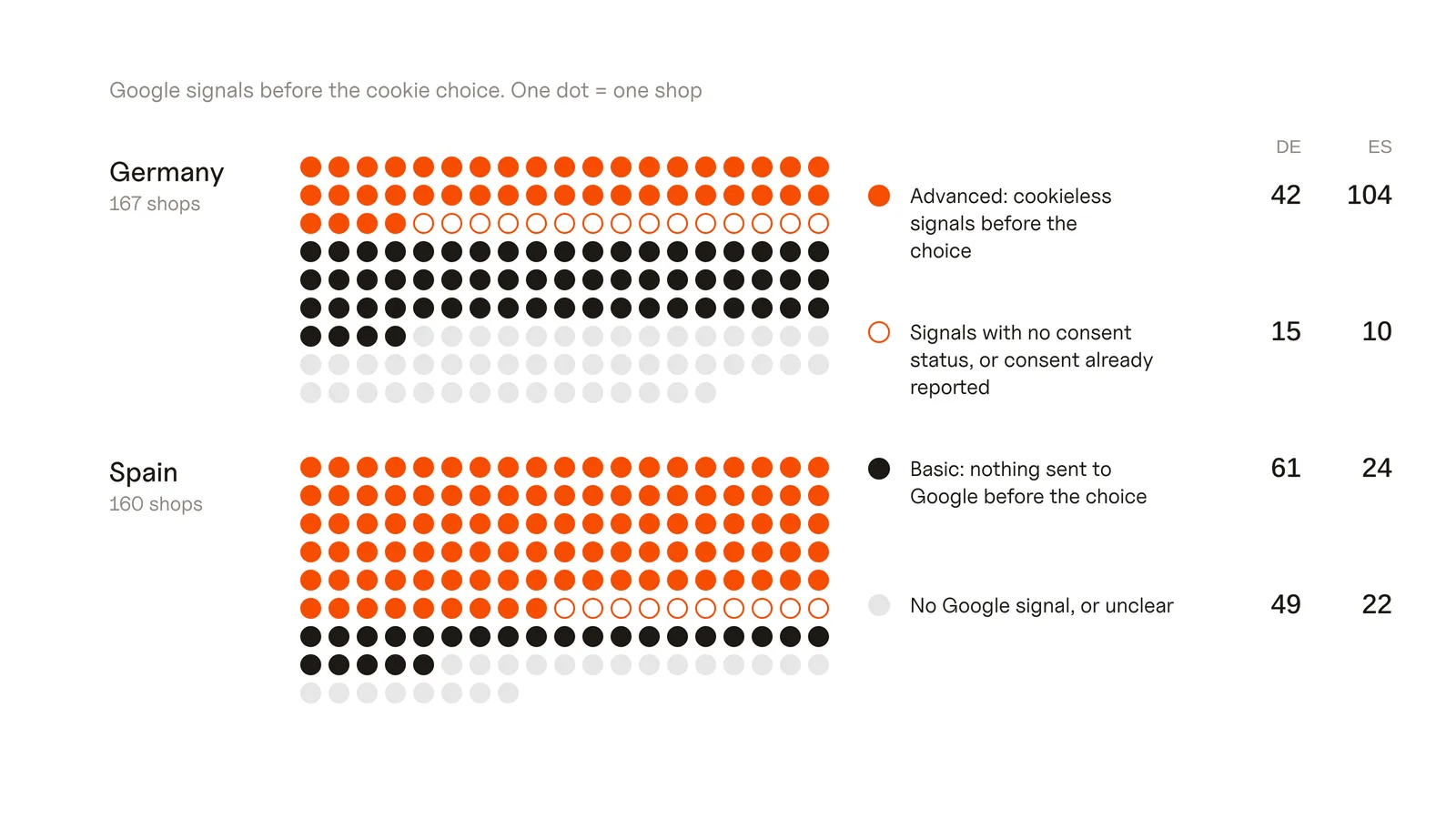
- Consent Mode setup: Advanced mode runs on 65% of Spanish and 25% of German shops. Basic mode, where nothing reaches Google before consent, runs on 37% of German and 15% of Spanish shops.
- Own domain: German shops more often serve Google tags from their own domain, 60% against 38% after consent.
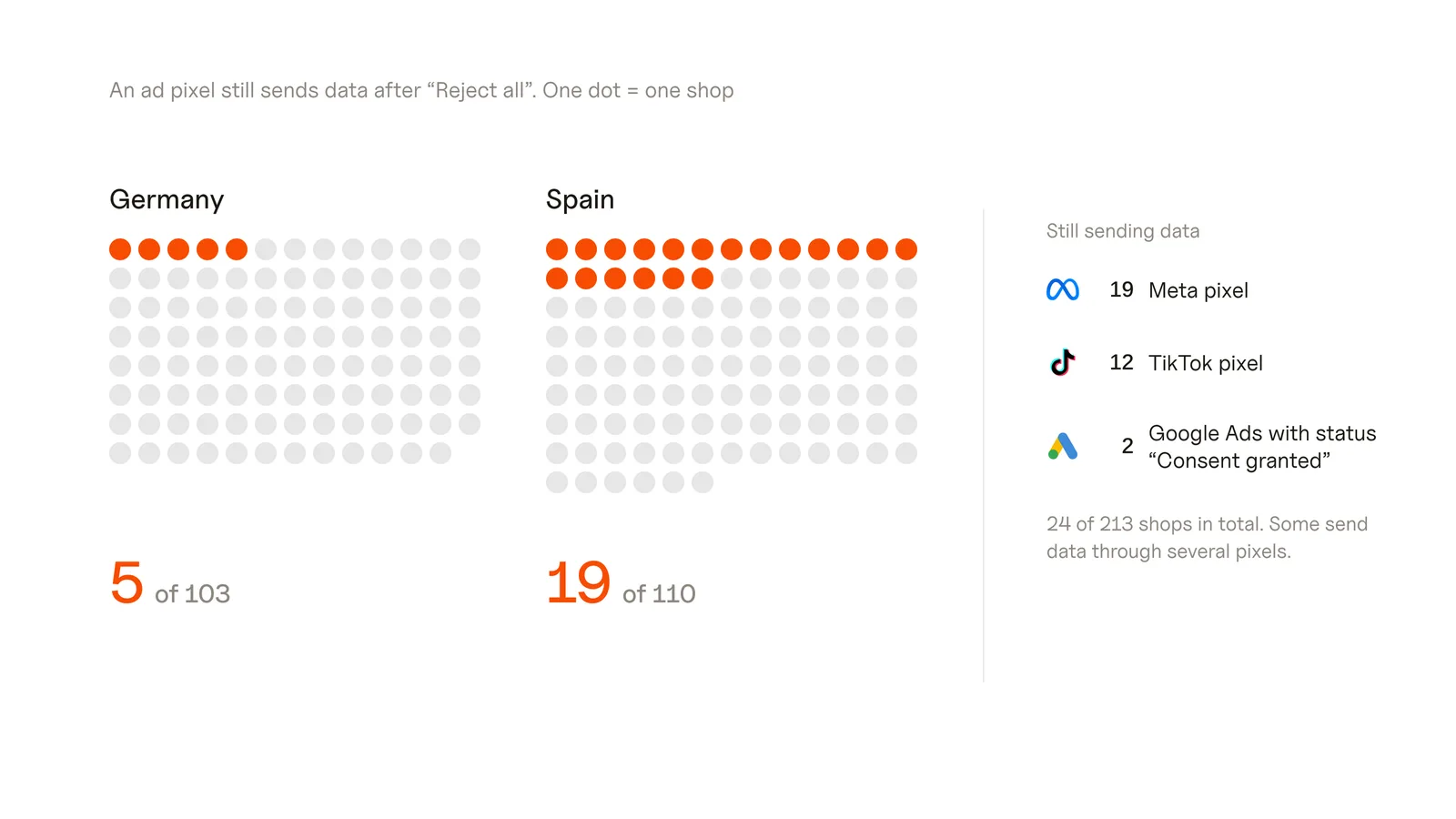
- After “reject all”: an ad pixel still sent data on 24 of 213 shops, 19 of 110 in Spain and 5 of 103 in Germany.
- Click ID: the gclid survives the homepage on 95% of shops. It is lost on 15 of 327, mostly through a redirect.
- Legal status: no court or authority in Germany or Spain has ruled on Advanced Consent Mode by name. The question is open in both countries.
- Your own shop: our free GCLID Checker runs six of the seven checks below.
Why this matters for your ad budget
Google Ads, Meta and TikTok bid automatically. They learn from the conversions your shop reports back. When conversions go missing, because visitors decline cookies, browsers delete them, or the click ID gets lost on the way, the algorithm learns from a partial picture and bids worse. No report shows this as an error. The campaign simply looks more expensive than it is.
A good part of this can be checked from outside, without access to anyone’s ad account. That is what we did.
The numbers at a glance
| Finding | Germany | Spain |
|---|---|---|
| Sends data to Google Ads before the cookie choice | 27% | 66% |
| Advanced Consent Mode (cookieless signals before the choice) | 25% | 65% |
| Basic Consent Mode (nothing reaches Google before consent) | 37% | 15% |
| Google tags served from the shop’s own domain, after consent | 60% | 38% |
| Click ID (gclid) survives the homepage | 98% | 93% |
| An ad pixel still sends data after “reject all” | 5 of 103 | 19 of 110 |
Finding 1: two countries, two consent strategies
Google Consent Mode has two ways of working, and the difference decides what Google learns about visitors who say no.
In Basic mode, Google tags stay blocked until the visitor accepts. If the visitor declines, nothing is sent to Google at all.
In Advanced mode, the tags load with consent set to denied and send signals without cookies. According to Google’s documentation, these signals contain, among other things, a timestamp, the browser’s user agent, the referring page and the consent state. Google says it uses them to estimate conversions from visitors who decline. In Basic mode a more general model applies. We found no independent test that measures how large the difference is; every uplift figure in circulation comes from Google or from consent-banner vendors.
Here is how the 327 shops are set up:
| Setup | Germany (167) | Spain (160) |
|---|---|---|
| Advanced: cookieless signals before the choice | 42 | 104 |
| Basic: nothing reaches Google before the choice | 61 | 24 |
| Signals without any consent state | 7 | 7 |
| Ad consent reported as granted before the choice | 8 | 3 |
| No Google signal on the homepage, or unclear | 49 | 22 |
The same picture shows after a refusal. After “reject all”, 81 of 110 Spanish shops still send signals to Google Ads. In Germany 29 of 103 do.
The gap does not depend on which shops we picked. If we count only the shops taken from published rankings and our first hand-picked list, leaving out mid-size brands, the share sending data to Google Ads before the choice is 20% in Germany and 65% in Spain. Mid-size German brands use Advanced mode much more often than the large ranked shops: 19 of 44.
What this means for you. A shop in Basic mode gives Google almost nothing to work with for visitors who decline. With a compliant banner, a large share of visitors decline or ignore it, so the algorithm misses a large part of the picture. Whether Advanced mode is an option for your shop is a legal question that has not been decided (see below), and one for you and your data protection officer. If you stay in Basic mode, close the gap elsewhere: Finding 2 and the checklist show how.
Finding 2: own measurement infrastructure is more common in Germany
A shop can serve its Google tags from its own domain, through server-side tagging or Google’s tag gateway. Cookies then last longer in Safari, and fewer measurements are lost to ad blockers.
After “accept all”, 123 of 253 shops use such a first-party endpoint for Google: 74 of 123 in Germany, 49 of 130 in Spain. Half of the shops running Google Ads (112 of 226) load everything from Google’s domains only. In Spain that is 61%, in Germany 37%.
So the two markets compensate in opposite directions. German shops send less before consent but invest more in making the consented data robust. Spanish shops send more signals but more often rely on the standard third-party setup.
Whether a shop also runs a server-side connection to Meta (the Conversions API) cannot be seen from outside.
Finding 3: the click ID almost always survives
The gclid connects a sale to the ad click that caused it. On 312 of 327 shops it is still in the address after the homepage has loaded. On 15 shops it is lost, mostly through a redirect that drops it before any tag can read it: 4 in Germany, 11 in Spain.
That is the good news in this study, and it applies to the homepage. In practice, click IDs get lost more often later: on the way to a payment page, in forms, or between subdomains. If your conversions happen after the first visit, for example a qualified lead or a repeat order, the click ID has to be stored with the customer record. Our guide to offline conversion import shows how.
Finding 4: after “reject all”, not everything stops
On 213 shops the test browser could click “reject all”. Afterwards:
- the Meta pixel still sent data on 19 shops,
- the TikTok pixel on 12 shops,
- Google Ads received consent as “granted” on 2 shops.
Together that affects 24 of 213 shops: 5 of 103 in Germany and 19 of 110 in Spain. On 42 shops we found an advertising cookie from Google, Meta or TikTok after the refusal.
Before any choice at all, about one shop in six had already set an advertising cookie (51 of 327).
We do not judge this legally. From a measurement point of view it is a defect either way: the audiences and conversions of these shops contain visitors who do not belong there, and the banner does not do what it promises.
Finding 5: the tag stack after consent
After “accept all” (253 shops) we found these platforms:
| Platform | Share of shops |
|---|---|
| Google Ads | 89% |
| Google Analytics 4 | 87% |
| Meta | 80% |
| Microsoft Ads | 59% |
| TikTok | 46% |
| 45% | |
| Criteo | 34% |
| Awin | 30% |
| RTB House | 25% |
Criteo is more common in Germany (54 of 123 shops) than in Spain (32 of 130). TikTok is more common in Spain (52% against 41%).
The legal frame, briefly
This section summarises public sources as of November 2026. It is not legal advice.
| Germany | Spain | |
|---|---|---|
| Provision | § 25 TDDDG | Art. 22.2 LSSI |
| Basic rule | Consent before information is stored on or read from the device; exception only for what is technically necessary | The same rule, the same narrow exception |
| Enforcement | State data protection authorities | AEPD |
| Maximum fine under the cookie provision | 300.000€ | 30.000€ per minor infringement |
| Regulator guidance | DSK guidance on digital services (11/2024) | AEPD cookie guide (05/2024) |
| “Reject” on the first layer | Equivalent to “accept” whenever visitors must interact with the banner | On the same layer and as visible as “accept” |
The law is the same at its core. The practice of the regulators differs. The AEPD regularly issues small fines for cookies set before the choice or after a refusal; in the cases we read they were mostly between 3.000€ and 12.000€. German authorities work more with sweeps and letters. Saxony checked about 30.000 websites in 2024 and wrote to 2.300 operators about Google Analytics without valid consent. Hamburg found third-party services before consent on 185 of 1.000 randomly chosen websites in 2025.
There is no decision on Advanced mode. As far as our research goes, no authority and no court in Germany or Spain had assessed Consent Mode or cookieless signals by name by November 2026. The EDPB’s Guidelines 2/2023, which are not binding, place transmissions triggered by scripts within the scope of the cookie rule, but leave the exemptions open. The Administrative Court of Hanover ruled in March 2025, according to law-firm reports, that loading Google Tag Manager itself requires consent; we do not know whether that judgment is final. The question is open in both countries.
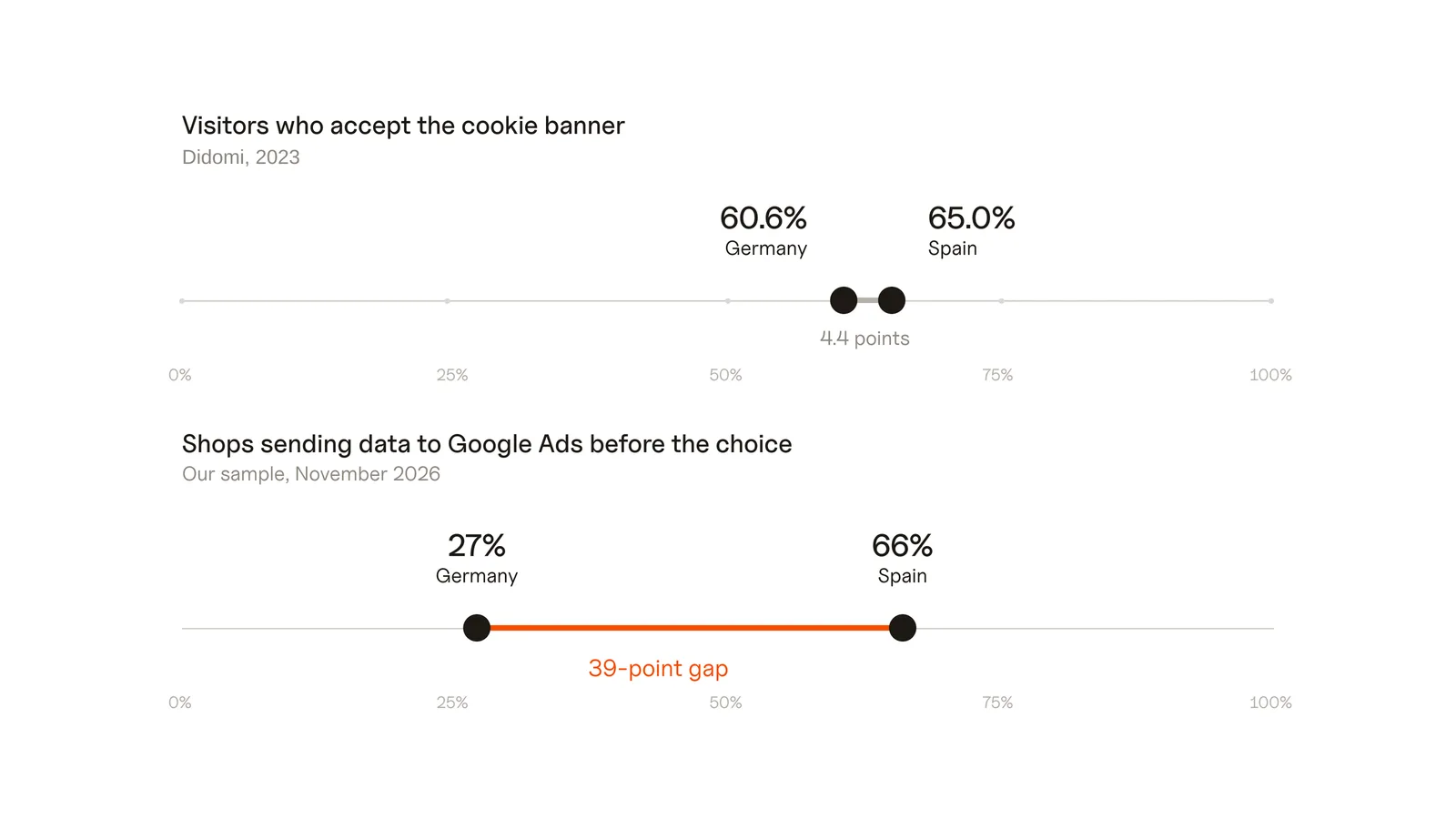
Visitors do not explain the gap. According to consent-banner vendor Didomi, 60.6% of visitors in Germany and 65.0% in Spain opted in when shown a banner in 2023. Visitors differ by a few points. The shops in our sample differ by about forty. We found no published study that compares large shops in both countries on these points.
What to take from this
- Your consent setup is a business decision. Basic or Advanced decides how much the algorithm learns about visitors who decline. Make that choice deliberately, with marketing and data protection at the same table, and not as the default of your banner vendor.
- If you may send little, send that little completely. First-party endpoints, server-side connections and the order value in every conversion make up part of the gap.
- “Reject” has to reject. A pixel that keeps sending after a refusal corrupts your own data first.
Seven checks for your own shop
Our free GCLID Checker runs the first six in one pass. It opens your page in a real browser, declines the cookie banner once, accepts it once, and reports the result in plain words. By hand it works like this:
- Does the click ID arrive? Open your shop in a private window with
?gclid=test123in the address. Is the gclid still there after the page has loaded? - Is it stored? Click “accept all”. Is your test value saved afterwards, in the
_gcl_awcookie or in local storage under_gcl_ls? Newer Google tags use local storage. - Does it last? Repeat this on a subpage and through to the checkout. Does the click ID survive every redirect?
- Is a “no” respected? In a new private window, click “reject all” and open your browser’s network tab. Do requests still go to
facebook.com/troranalytics.tiktok.com? - Basic or Advanced? Check whether requests go to Google before your choice (Advanced) or only after you accept (Basic), and whether that was a deliberate decision.
- Own domain? Check whether your Google tags load from
googletagmanager.comor from your own domain. - Is the conversion right? In Google Ads, check that every purchase conversion carries the real order value and a transaction ID, so no sale is counted twice. Only someone with account access can see this. The checker does flag a conversion that fires on an ordinary page view.
Two notes on the checker. It tests from a server in the US, so if your shop shows the banner only to visitors in Europe, it cannot check points 4 and 5, and it says so. And a single run can miss something: a flagged problem is worth checking, a clean result is not proof.
How we measured
- Sample: 400 online shops, 200 each from Germany and Spain. We picked 100 ourselves (first wave). 300 come from public rankings (second wave): for Germany the EHI lists of the 100 highest-revenue online shops and category rankings, for Spain a ranking by visits from October 2026, plus well-known mid-size brands. Pure marketplaces, travel and business-only shops are not included.
- Measurable: 327 shops, 167 German and 160 Spanish. 72 blocked the test browser or did not load, among them some of the largest brands. One led to another country’s storefront.
- Procedure: load the homepage with a test click ID (gclid and gbraid) and wait nine seconds without touching the banner. Then, in separate runs, click “accept all” and “reject all” and reload.
- What counts: only real data transmissions to the ad platforms, not the mere loading of a script. We read the consent state from the transmission itself.
- Dates: 10 and 12 November 2026.
Limits. This is a sample, not a representative survey. We tested the homepage only, not the checkout, and each shop once per run. All measurements ran from a Spanish internet connection; some German shops may show a different banner there. The test browser found the “accept” button on 253 shops and the “reject” button on 213. We name no shops and make no legal assessment.
FAQ
What is the difference between Basic and Advanced Consent Mode?
In Basic mode, Google tags are blocked until the visitor accepts cookies, so nothing reaches Google from visitors who decline. In Advanced mode, the tags load with consent denied and send signals without cookies, which Google uses to estimate conversions from those visitors.
Is Advanced Consent Mode allowed in Germany or Spain?
It has not been decided. By November 2026, no authority or court in either country had assessed Consent Mode or cookieless signals by name. Non-binding EU guidelines read script-triggered transmissions as covered by the cookie rule but leave the exemptions open. Clarify it with your data protection officer.
How many shops send data to Google before the cookie choice?
In our sample of 327 shops, 66% of Spanish and 27% of German shops sent data to Google Ads before any choice, almost all of them without cookies through Advanced Consent Mode.
Do ad pixels really keep sending after “reject all”?
On 24 of the 213 shops where our test browser could click “reject all”, a Meta or TikTok pixel still sent data or Google received consent as granted: 19 of 110 shops in Spain and 5 of 103 in Germany.
How can I check my own shop?
Run the free GCLID Checker. It tests whether the click ID is stored and kept, whether a refusal is respected, which Consent Mode you run and where your Google tags are served from. The seven manual checks above cover the same ground.
Key takeaways
- Germany and Spain apply the same consent rule, yet their shops are set up very differently: 66% of Spanish shops send data to Google Ads before the cookie choice, 27% of German shops do.
- The difference is the Consent Mode: Advanced on 65% of Spanish shops, Basic on 37% of German shops.
- German shops more often serve Google tags from their own domain (60% against 38%), which makes consented data more robust.
- After “reject all”, an ad pixel still sent data on 24 of 213 shops, most of them in Spain.
- Nobody has ruled on Advanced Consent Mode in either country. Treat it as a deliberate decision with your data protection officer, and test what your shop actually sends.