



ROAS (return on ad spend) tells you how much revenue each euro of advertising brings in: attributed revenue divided by ad spend. Spend 10.000€, get 40.000€ in attributed sales, and your ROAS is 4.0 (or 400%). POAS (profit on ad spend) puts gross profit on top of the fraction instead of revenue. iROAS (incremental ROAS) keeps only the revenue that would not have happened without the ads.
The three answer different questions, and on the same campaign they can point in opposite directions.
The three formulas
| Metric | Formula | The question it answers |
|---|---|---|
| ROAS | Attributed revenue ÷ ad spend | How much does the platform say this campaign sold? |
| POAS | Attributed gross profit ÷ ad spend | Does the margin cover what I spend on ads? |
| iROAS | Incremental revenue ÷ ad spend | How much did this campaign sell that wouldn’t have sold anyway? |
As a percentage: ROAS (%) = (revenue ÷ ad spend) × 100, so a ROAS of 4.0 is 400%. Google Ads uses the percentage form for Target ROAS.
Break-even ROAS = 1 ÷ gross margin. At a 50% margin you need a ROAS of 2.0 just to break even; at 25% you need 4.0. There is no universal “good ROAS”, only one that is good for your margin.
One campaign, three answers
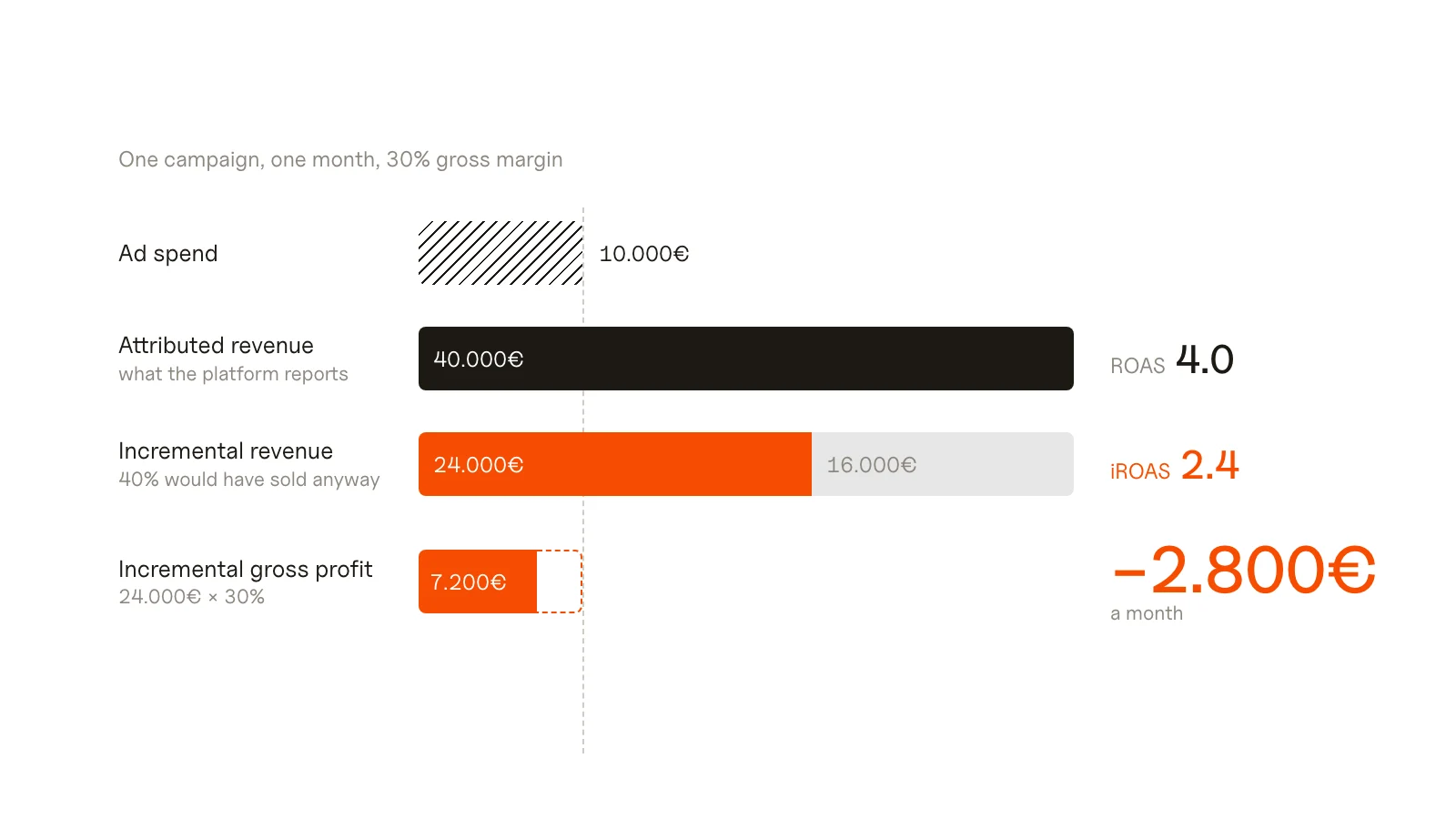
Illustrative example with round numbers. An online shop spends 10.000€ a month on a campaign, and the platform attributes 40.000€ in sales to it. Gross margin is 30%.
| Calculation | Result | What it says | |
|---|---|---|---|
| ROAS | 40.000 ÷ 10.000 | 4.0 | Looks healthy |
| POAS | (40.000 × 30%) ÷ 10.000 | 1.2 | The margin covers the spend, with 2.000€ left over |
| Break-even ROAS | 1 ÷ 0.30 | 3.33 | The floor for not losing money |
| iROAS | 24.000 ÷ 10.000 | 2.4 | A holdout test shows 40% of those sales would have happened anyway |
On incremental numbers, the campaign drives 24.000€ of extra sales, which is 7.200€ of incremental gross profit for 10.000€ of spend: it loses 2.800€ a month, while the dashboard shows a 4.0 ROAS. The 40% gap is not an extreme assumption. Across published incrementality studies, measured iROAS usually lands 30 to 60 percent below platform-reported ROAS, worst on retargeting and brand search. Our attribution vs incrementality guide explains why.
When to use which
- ROAS: for daily steering and bidding. Google Ads (Target ROAS) and Meta optimize on it, so it’s the language the platforms speak.
- POAS: when your products have very different margins. A campaign that sells lots of low-margin items can show a high ROAS and a weak POAS. Send margin as the conversion value and the platforms bid on profit instead; our post on dynamic conversion values shows how.
- iROAS: for splitting budget between channels. It’s the only one of the three that measures cause rather than credit, and it needs a holdout or geo-lift test.
How we use it
We bid on ROAS, audit on POAS and set budgets on iROAS, and we don’t treat any of them as the goal. On the GetYourGuide ML bidding project, the new bidding model lifted ROAS 81% while net revenue fell 16%. That trade-off was modeled and agreed in advance because cost dropped 54%, but it makes the point: ROAS is a ratio, and it doesn’t tell you whether the business is growing. To find out which of your channels are really incremental, our attribution and incrementality service designs and reads the tests.
FAQ
What is a good ROAS?
One that clears your break-even ROAS (1 ÷ gross margin) with enough room to cover your other costs. At a 40% margin, break-even is 2.5: a ROAS of 3 leaves little room, a ROAS of 5 leaves plenty.
What’s the difference between ROAS and ROI?
ROAS only compares revenue with ad spend. ROI compares profit with all costs (product, shipping, team, tools). A campaign can have a ROAS of 4 and a negative ROI.
How do you calculate iROAS?
Divide incremental revenue by ad spend. Incremental revenue comes from comparing a group that sees your ads with a control group that doesn’t (holdout, geo lift or conversion lift). Without that test you don’t have iROAS, only ROAS.
Can I bid on POAS in Google Ads?
There’s no “Target POAS” strategy, but you get the same result by sending profit (or margin) as the conversion value and using Target ROAS. The platform then optimizes for profit instead of revenue.
Sources: Google Ads Help: Target ROAS