



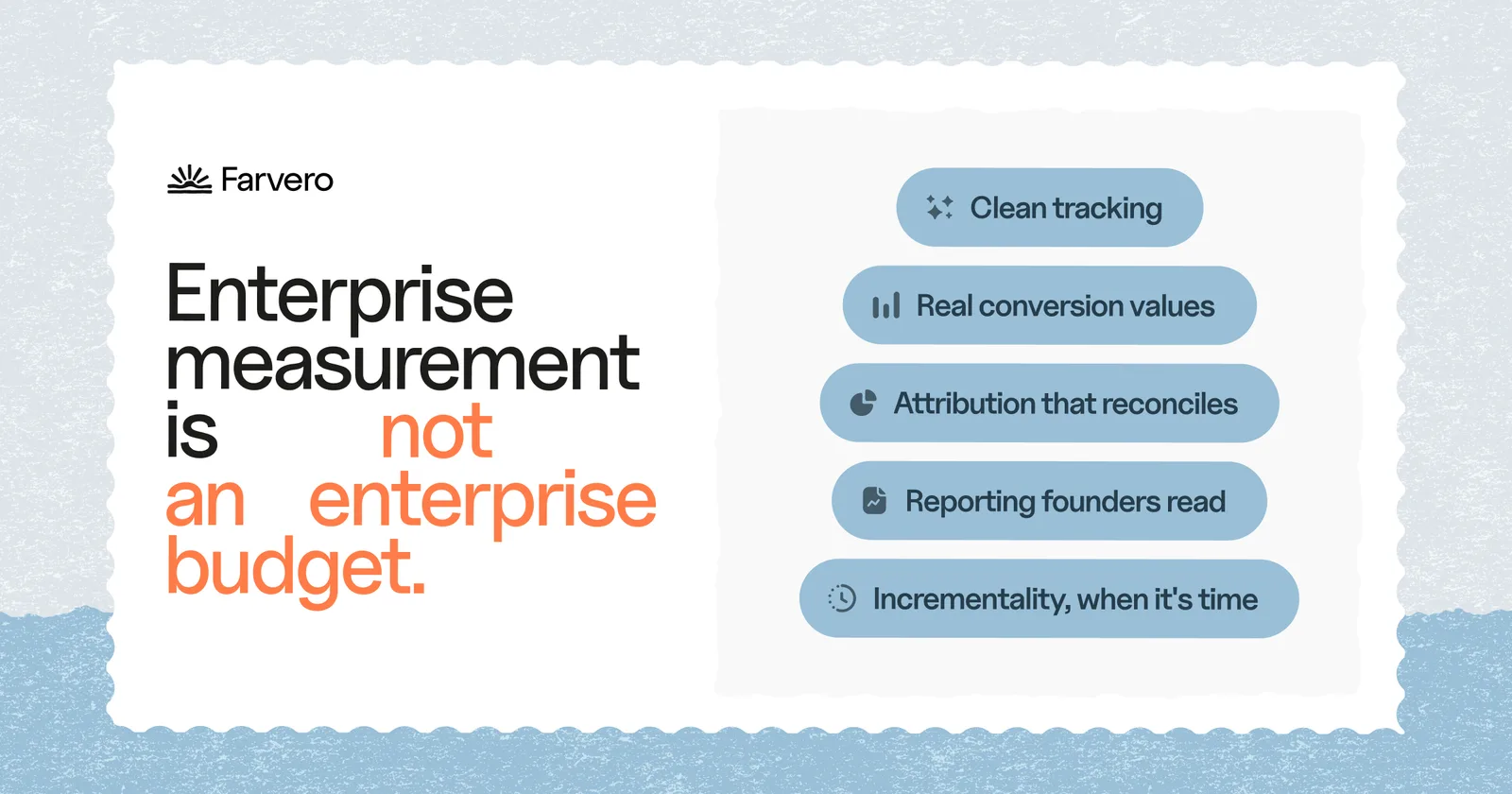
Enterprise measurement is not an enterprise budget. It is a set of capabilities: tracking that survives ad blockers and privacy rules, conversion values that reflect real revenue, attribution you can trust, a read on incrementality, and reporting a founder actually opens. Most startups assume that stack needs a data team, a six-figure tooling contract, and six months. It does not.
I spent four years at GetYourGuide running measurement at enterprise scale, then rebuilt the same fundamentals for startups like Liesl for roughly the cost of a few monthly SaaS tools. The gap between the two is not budget. It is knowing which parts matter at your stage, and which parts are enterprise overhead you can skip for now.
Here is the whole playbook.
TL;DR
- Enterprise measurement is five capabilities, not a budget: clean server-side tracking, real conversion values, trustworthy attribution, an incrementality read, and founder-friendly reporting.
- A startup can get 80% of the enterprise measurement stack for under 100€/month in tooling, run by one senior operator, in weeks rather than quarters.
- Build in this order: fix tracking first, then values, then attribution, then reporting. Incrementality comes last, once spend is big enough to test.
- Skip the enterprise overhead you do not need yet: a CDP, marketing mix modeling, a full data team, and multi-touch attribution models that need volume you do not have.
- The expensive mistake is scaling spend on broken measurement. Every week on bad data, Smart Bidding optimizes toward the wrong people, and that budget does not come back.
What “enterprise measurement” actually means
Strip away the tooling and enterprise measurement is five jobs:
- Clean data capture. Your tracking sees what actually happens: purchases, signups, bookings, and their real value, even when browsers, ad blockers, and consent rules try to hide them.
- Real conversion values. Every conversion carries the revenue or margin it is actually worth, not a flat “1,” so bidding chases profit instead of volume.
- Trustworthy attribution. You know, within reason, which channels drove which outcomes, and the numbers roughly reconcile across GA4, the ad platforms, and your backend.
- An incrementality read. You can tell the difference between conversions your ads caused and conversions that would have happened anyway.
- Reporting a decision-maker uses. One view that pulls web, app, and backend into a funnel the founder reads in plain language, not a 30-page PDF of impressions.
An enterprise does each of these with a team and a large stack. A startup needs the same five outcomes. It does not need the same machinery.
The startup-sized stack, in build order
Measurement-first means exactly that: you fix the data layer before you scale a single campaign. The order matters, because each layer depends on the one below it.
1. Tracking (do this first)
Browser-only tracking misses 30-40% of conversions in 2026 to ad blockers, Safari ITP, and consent gating. If the platform cannot see the conversion, it cannot optimize toward it, and you pay for the gap.
The fix is server-side tracking: route conversions through your own server so ad blockers and browser limits stop deleting your signal. Managed hosting on Stape is about 20€/month. I wrote the full technical build in my server-side GTM guide; the point here is that this is a weeks-long job for one person, not a data-team project.
For Liesl I built this from zero: GTM, server-side GTM, GA4, Google Ads, Meta CAPI, event deduplication, Enhanced Conversions, and Swiss-compliant consent.
2. Conversion values
Once the data is clean, tell the platforms what a conversion is worth. A booking worth 400€ and a booking worth 40€ should not both send “1.” When they do, the algorithm floods you with the cheapest, lowest-intent conversions it can find, and revenue stalls while your cost-per-conversion target still looks fine.
Passing dynamic values, and then bidding on value rather than volume, is what moves revenue. For Liesl I extended tracking into the app with Adjust and Firebase specifically so real booking value flowed into bidding, then migrated the account to value-based bidding. This is table-stakes at enterprise scale and still rare among startups.
3. Attribution you can reconcile
You do not need a multi-touch attribution model at seed stage. You need your numbers to roughly agree. When GA4 says 50 conversions, Google Ads says 120, and your CRM says 35, you cannot make a confident decision on any of them.
Clean server-side tracking plus consistent conversion definitions gets most startups to “the numbers reconcile” without buying an attribution platform. That is enough to allocate budget honestly. Sophisticated modeling is a later-stage problem.
4. Reporting the founder reads
The last build job is making it visible. At enterprise scale this is a BI team. At startup scale it is one well-built dashboard that pulls web, app, and backend into a single funnel view, in the language the founder uses.
For Liesl I built exactly that: a live, founder-friendly dashboard that replaced monthly PDFs with a view of the whole business at a glance. As their CEO put it, it moved them “from intuition-based discussions to evidence-based decisions.”
5. Incrementality (last, and only when spend justifies it)
Incrementality is the most enterprise of the five, and the one startups should defer. It settles the question attribution cannot: whether your ads caused the sale or just took credit for it. Geo-tests and holdout experiments need enough spend and volume to produce a readable signal. Run them once your budget is large enough that a few percentage points of wasted spend is real money. Before that, clean tracking and honest values give you most of the truth.
What to skip (for now)
The fastest way to blow a measurement budget is to buy enterprise tooling for enterprise problems you do not have yet. At startup stage, skip:
- A CDP. Server-side GTM covers most of what an early-stage company needs a customer data platform for, at a fraction of the cost.
- Marketing mix modeling. MMM needs years of data and large spend to be trustworthy. It is noise at your stage.
- A full data team. One senior operator who speaks both SQL and marketing covers the build. Hire the team when the volume forces it.
- Multi-touch attribution models. They need conversion volume most startups do not have. The model will confidently report numbers built on too little data.
Telling you not to buy these is the point. Enterprise measurement at startup scale is as much about what you skip as what you build.
Enterprise vs startup: the same outcomes, a different path
| Enterprise approach | Startup-sized approach | |
|---|---|---|
| Team | Data team, analysts, BI | One senior operator |
| Tooling cost | Five to six figures / year | Under 100€/month |
| Time to stand up | Quarters | Weeks |
| Tracking | In-house server infrastructure | Managed sGTM (Stape, ~20€/mo) |
| Attribution | Custom MTA or MMM | Clean tracking, reconciled definitions |
| Incrementality | Continuous geo-testing | Deferred until spend justifies it |
| Reporting | BI platform and team | One founder-friendly dashboard |
The right column is not a watered-down version of the left. For a company spending 5.000€ to 50.000€ a month, it is the correct version. You get the enterprise result without paying for enterprise machinery you would not use.
What to expect
Clean tracking and real values are not an instant lift. Ad platforms need two to four weeks to relearn once the signal improves. What is immediate is that you can finally trust your own numbers, which is the thing that lets you scale spend without flying blind.
Realistically, a startup can go from broken tracking to a trustworthy measurement stack in four to eight weeks, with one senior person, for under 100€/month in tooling. That is the whole thesis: enterprise measurement, minus the enterprise.
FAQ
Do I need a data team for good measurement?
No. One senior operator who understands both the marketing and the plumbing (GTM, server-side tracking, SQL) can build the full startup-sized stack. A data team is what you hire when conversion volume and complexity outgrow one person, not before.
How much does enterprise-grade tracking cost for a startup?
The tooling is the cheap part: managed server-side GTM hosting runs about 20€/month, and the rest of the startup stack fits under 100€/month. The real cost is senior time to build it correctly once.
Is server-side tracking overkill for a small company?
No. It is more valuable the smaller you are, because you cannot afford to waste 30-40% of your signal or your budget. Broken tracking hurts a startup more than an enterprise, not less.
When should I invest in incrementality testing?
When your spend is large enough that a few percent of wasted budget is meaningful, and your volume is high enough to read a holdout or geo-test. For most startups that is later. Fix tracking and values first.
What is the single highest-priority fix?
Tracking, every time. Values, attribution, and reporting all sit on top of it. If the data capture is broken, everything built on it inherits the error.
Key takeaways
- Enterprise measurement is five capabilities, not a budget: clean tracking, real values, reconciled attribution, incrementality, and founder-friendly reporting.
- Build in order: tracking, then values, then attribution, then reporting. Defer incrementality until spend justifies it.
- A startup can stand up 80% of the enterprise stack in weeks, with one senior operator, for under 100€/month.
- Skip the enterprise overhead you do not need yet: CDP, MMM, a full data team, and volume-hungry attribution models.
- The costly mistake is scaling spend on broken measurement. The signal you lose while flying blind does not come back.
If you want a second opinion on where your measurement actually stands, I offer a free tracking check: a short teardown of what your setup is capturing, what it is missing, and what to fix first. Even just to sanity-check that you are not scaling on numbers you cannot trust.