



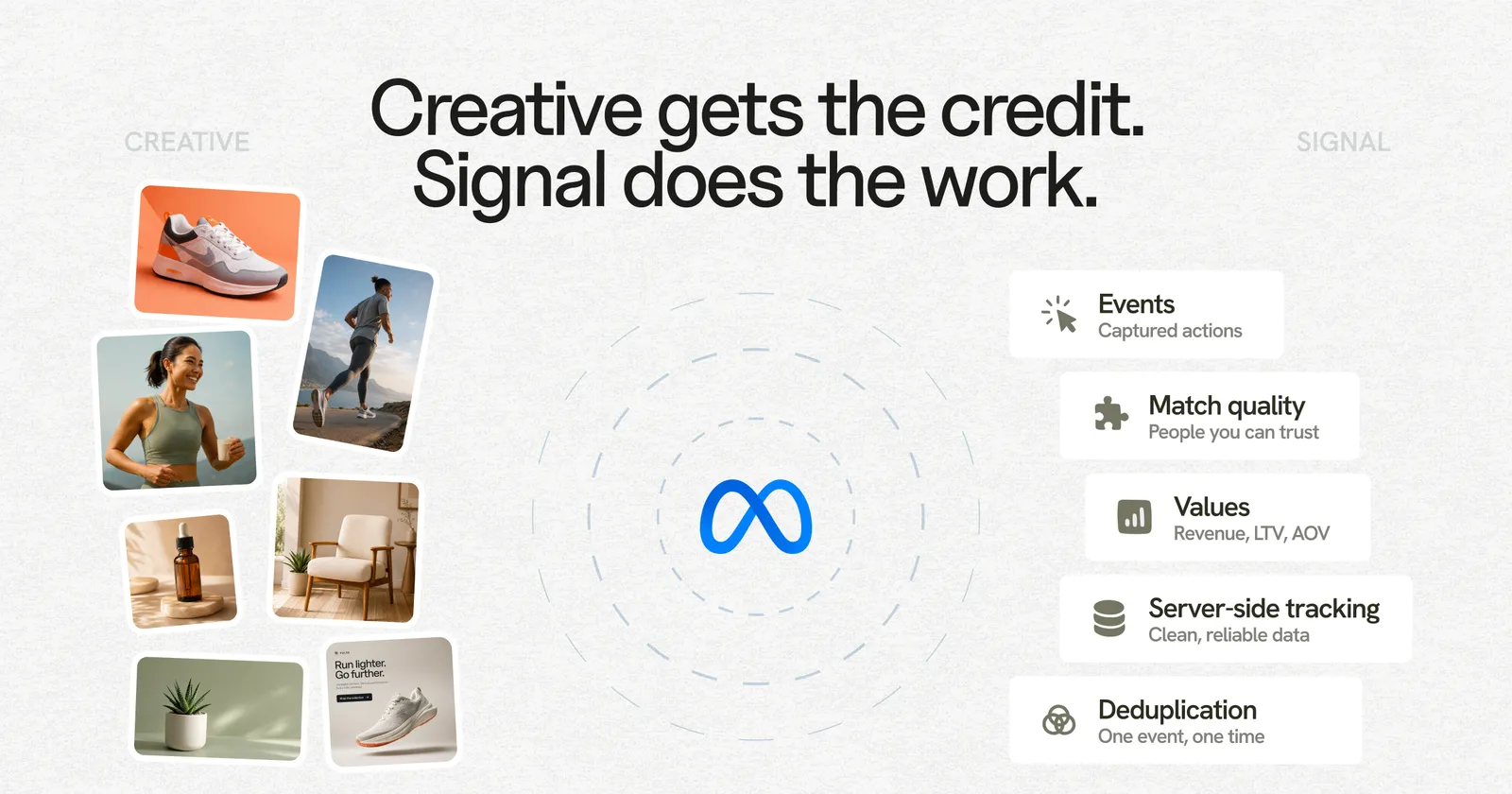
Since late 2024, Meta’s Andromeda has been the AI retrieval system behind ad delivery, and by 2026 it is the default for every advertiser, with no opt-out. It reads your creative to decide who sees your ads. The standard advice is therefore “ship more creative.” That advice is half right, and the missing half is the one that decides whether more creative means more profit or faster waste.
I run paid acquisition and tracking for B2C startups, and Andromeda has changed almost every Meta conversation I have. Founders arrive with the same playbook: more variants, broader targeting, consolidated campaigns. Almost nobody arrives asking about the conversion signal all of that machinery optimizes toward.
Here is what Andromeda actually changed, what the creative-volume advice gets right, and why signal quality is the multiplier on everything else.
TL;DR
- Andromeda, announced December 2024, replaced Meta’s layered ad-ranking stack with a single transformer model: roughly 10,000x more model capacity and an 8% improvement in ad ranking quality, by Meta’s own numbers. It is the default for all advertisers. There is no setting to turn it off.
- Targeting moved into the creative. Audience-level tweaks matter less; the system infers who should see an ad from the ad itself and from engagement signals.
- The standard response is creative volume: 10-15 distinct concepts, broader campaigns, faster refresh cycles as fatigue windows shrink from six weeks to two or three.
- The under-covered lever is conversion signal quality. A browser-only pixel captures roughly 70-80% of conversions, and less on iOS. Meta’s own figure: running Conversions API alongside the pixel delivers 17.8% lower cost per result.
- One-click CAPI, launched April 2026, is a floor, not a clean setup. It mirrors your pixel, gaps included: no custom events, capped Event Match Quality, web and Meta only.
What Andromeda actually is
Andromeda is Meta’s ad retrieval engine, announced in December 2024 and fully rolled out as the default across Facebook, Instagram, and WhatsApp inventory by early 2026. Technically, it replaced a hand-tuned, layered ranking stack with a single transformer model that scores tens of millions of ad candidates in parallel instead of narrowing them down in stages.
Meta’s published numbers: an 8% improvement in ad ranking quality and roughly 10,000x more model capacity than the previous system.
For advertisers, the architecture matters less than the consequence. The system no longer needs your audience definitions to figure out who should see an ad. It infers that from the creative itself and from how people react to it. Your interests, lookalikes, and exclusion lists still exist, but their relative contribution has dropped. Practitioners increasingly describe audience-level optimizations as noise.
That is the real meaning of “creative is the new targeting.” Each ad is now a targeting input. A campaign with three similar ads gives the model three similar hypotheses. A campaign with fifteen distinct concepts gives it fifteen different doors into the auction.
What the creative-volume advice gets right
The industry response to Andromeda has converged on a playbook, and the direction is correct:
- More distinct concepts, matched to budget. The headline advice is 10-15 conceptually different assets per campaign, and high-velocity teams on large budgets ship 15-40 new variants a week. On 5.000–50.000€ a month that pace is neither affordable nor necessary: aim for 4-8 genuinely different concepts in rotation and refresh them as they fatigue. Every ad still needs enough spend to leave the learning phase (roughly 50 conversions a week per ad set), so let budget set the volume, not the other way round. Distinct means different hooks, formats, and angles, not the same ad with a new background color.
- Broader, consolidated campaigns. Tight audience splits starve the model of the comparison signal it needs, and at this budget you cannot afford to spread it thin across many ad sets anyway. Fewer campaigns, fewer ad sets, more creatives per ad set.
- Faster refresh. Ad fatigue windows have compressed from six-plus weeks to two or three. Learning phases for well-differentiated creatives have dropped from 24-48 hours to as little as 6-12, though at smaller budgets they still run longer, because the phase closes on conversion count, not on the clock.
- Watch concentration. If a single ad takes more than about 40% of campaign spend, your library is too narrow and the model has stopped exploring.
The case studies are real. Taxfix, working with a creative-volume approach on Meta UK, reported a 45% CTR lift and a 20% drop in CPA. None of this is wrong.
However, it is half the system.
The half nobody budgets: what the machine optimizes toward
Creative decides who sees your ads. Your conversion data decides what “working” means. Andromeda is a prediction engine, and every prediction is scored against the conversion events you send back. If those events are incomplete or wrong, the system executes the wrong objective with 10,000x more capacity than before.
The gap is not hypothetical:
- A browser-only Meta Pixel captures roughly 70-80% of conversions. Ad blockers affect an estimated 25-30% of users, Safari caps cookies, and iOS App Tracking Transparency wiped out 40-60% of signal on Apple devices.
- Meta’s own figure: advertisers running Conversions API alongside the pixel see 17.8% lower cost per result. That is Meta telling you how much performance sits in signal quality alone.
- Match quality compounds it. Meta scores every event’s Event Match Quality from 0 to 10. Server-side events carrying only an email match around 5-6. Adding hashed phone, name, and external_id lifts events to 8 and above. Below that, Meta receives your conversion but matches it to fewer real people, so the model learns from a blurrier picture.
Here is the uncomfortable arithmetic. If your tracking misses a quarter of conversions and matches the rest poorly, then doubling creative output doubles the speed at which Andromeda optimizes toward the wrong target. Signal quality is not a parallel workstream to creative. It is the multiplier on it.
One-click CAPI is a floor, not a fix
In April 2026 Meta shipped one-click Conversions API: server-side events with no developer, enabled from Events Manager. Since then, most audit calls I take open with some version of “we’re covered now.”
Give it its due first. One-click mirrors your pixel’s web events server-side, past the ad blockers and browser limits. It deduplicates automatically. It is free. Turn it on.
But be precise about what it is: a mirror of your pixel, not a configurable setup. In Meta’s own words, event and parameter selection are not configurable. That means:
- No custom events. It mirrors the standard web events (PageView, ViewContent, AddToCart, InitiateCheckout, Purchase) and nothing you defined. Subscription starts, qualified-lead tiers, and upsell events stay browser-only, and those are exactly the high-intent signals value-based bidding needs.
- Capped Event Match Quality. Because it only mirrors the pixel, it cannot attach the server-side match keys that lift EMQ from the 5-6 range to 8+. The events arrive; they just match fewer people.
- Web and Meta only. No offline or CRM conversions (those need a separate integration), and nothing for Google Ads Enhanced Conversions or TikTok Events API.
- It mirrors your mistakes. If your pixel fires before consent or misses purchase value, the server copy inherits all of it. In the EU, consent has to gate both paths or neither.
I wrote a five-point self-check for exactly this; it is linked at the end of this post.
The clean setup, in build order
This is the sequence I use with clients, and the order matters:
1. Fix consent first. Both pixel and CAPI must respect the same consent state. Anything else is a compliance problem and a data-quality problem at once.
2. Move CAPI to server-side GTM. A proper server-side setup, not the mirror, lets you control events, attach match keys, and route the same clean stream to Meta, Google, and GA4. I covered the full build in my server-side GTM guide. For Liesl I built this from zero: GTM, server-side GTM, GA4, Google Ads, Meta CAPI, event deduplication, Enhanced Conversions, and Swiss-compliant consent.
3. Send your real events with real values. Custom high-intent events and actual conversion values, not a flat “1” per conversion. Under Andromeda this is what separates “more conversions” from “more profit.”
4. Verify deduplication. Pixel plus CAPI means every event exists twice. Matching event IDs tell Meta they are the same conversion. Get this wrong in a custom setup and you either double-count or lose events.
5. Monitor Event Match Quality like a KPI. Open Events Manager, check EMQ per event, and treat anything below 7 on a purchase event as a work item. Hashed phone, name, and external_id are usually the fastest lift.
Then, and only then, scale the creative machine. Every additional variant now feeds a system that is optimizing toward reality.
Common mistakes I keep seeing
- Scaling creative volume on a pixel-only setup. The model explores faster and learns from 70-80% of the truth.
- Treating one-click CAPI as the finish line. It is the starting line. The gaps above do not close themselves.
- Judging Andromeda performance during signal gaps. If EMQ jumped or CAPI went live mid-month, month-over-month comparisons break. Annotate the change.
- Keeping legacy micro-segmented structures. Ten campaigns with two ads each is the worst possible shape under Andromeda: no comparison signal, no exploration room.
- Sending every conversion as value “1.” Creative-based targeting plus volume-based bidding finds you the cheapest conversions available, indefinitely.
FAQ
What is Meta Andromeda?
Meta Andromeda is the AI retrieval system Meta uses to decide which ads are eligible to be shown to each person. It has powered ad delivery since late 2024 and is on for every advertiser, with no opt-out. It reads your creative to match ads to people, and it learns from the conversion events you send back, so the quality of that signal shapes who it finds for you.
Do I need to do anything to “turn on” Andromeda?
No. It has been the default delivery system across Meta inventory since early 2026, for every advertiser, with no opt-out. The question is not whether you use it but whether your inputs help it or starve it.
Is audience targeting dead on Meta?
Not dead, demoted. Broad targeting with a diverse creative library generally outperforms tight segments now, because the model infers audiences from creative and engagement. Exclusions and hard constraints still have their place; hand-tuned micro-segments mostly do not.
How many creatives do I actually need?
Common practitioner guidance is 10-15 conceptually distinct assets per campaign, but that is calibrated for large budgets. On 5.000–50.000€ a month, 4-8 genuinely distinct concepts in rotation is usually plenty, because each ad needs enough spend to exit the learning phase. Refresh as fatigue appears (now within two to three weeks). Concentration is the better health check than any fixed count: one ad above roughly 40% of campaign spend means the model has stopped exploring.
Is one-click CAPI worth enabling at all?
Yes, immediately. It recovers signal that ad blockers and browser limits delete, and Meta cites 17.8% lower cost per result for pixel-plus-CAPI setups. Just do not confuse it with a clean, configurable server-side setup. It mirrors your pixel, gaps included.
What Event Match Quality score should I aim for?
Meta scores 0-10 per event. Email-only server events typically sit around 5-6. With hashed phone, name, and external_id you can reach 8+. I treat below 7 on a revenue event as a work item, not a curiosity.
Key takeaways
- Andromeda made creative the targeting input. Volume and diversity are real levers, and the industry advice on them is directionally right.
- Creative decides who sees the ad. Conversion signal decides what the system optimizes toward. A 10,000x more capable model pointed at wrong data is faster waste.
- A browser-only pixel sees 70-80% of your conversions. Meta’s own number for fixing it: 17.8% lower cost per result with CAPI alongside the pixel.
- One-click CAPI is a floor. Custom events, match keys, values, and cross-platform routing still require a real server-side setup.
- Sequence matters: consent, server-side CAPI, real events and values, deduplication, EMQ. Then scale the creative machine.
If you want the quick version of the signal check, the five-point one-click CAPI self-check is on my LinkedIn, and the full review is part of every tracking and paid audit I run. It usually takes one pass through Events Manager to know whether your creative budget is compounding or leaking.
Sources: Meta Andromeda engineering announcement (December 2024; +8% ad ranking quality, ~10,000x model capacity); Superscale, “What is Meta Andromeda”; Meta, Conversions API (17.8% lower cost per result with Conversions API alongside the pixel); PPC Land on one-click Conversions API (scope, auto-deduplication); Digital Applied, Meta/TikTok CAPI 2026 (signal-loss ranges); Superscale, Taxfix case study (Taxfix Meta UK: +45% CTR, 20% lower CPA).