



Every app founder running paid acquisition eventually asks the same question: do we need a mobile measurement partner, or is Firebase enough? The honest answer is that they solve different problems. Firebase measures Google. An MMP measures everything else, and “everything else” is bigger than most comparisons admit. It is not just Meta and TikTok. It is your organic installs, your owned channels, and every deep link you send. Once you spend real money on more than one channel, you need both, and you need a clear decision about which source feeds which platform.
I spent a year building and debugging exactly this stack for a Swiss booking marketplace: Firebase and Adjust running in parallel, feeding Google Ads and Meta. Most of what I know about it, I learned from things that broke quietly.
This is the first post in a three-part series on app tracking. This one covers the architecture: why one tool is not enough, what an MMP actually measures, how the two pipelines run, and who should feed what. Part two covers the silent failure modes. Part three covers the iOS attribution gap that almost every app with web-to-app campaigns has right now.
TL;DR
- Firebase attribution only connects to Google Ads. Meta, TikTok, and other networks barely see Firebase data; installs and conversions from those channels end up misattributed or bucketed as organic.
- An MMP is not just a Meta workaround. A mobile measurement partner (Adjust, AppsFlyer, Branch, Airbridge) attributes installs and in-app events across every source: paid networks, organic, owned channels (email, on-site banners, offline/QR), and the deep links that power them. It sends conversions back to each network server-side.
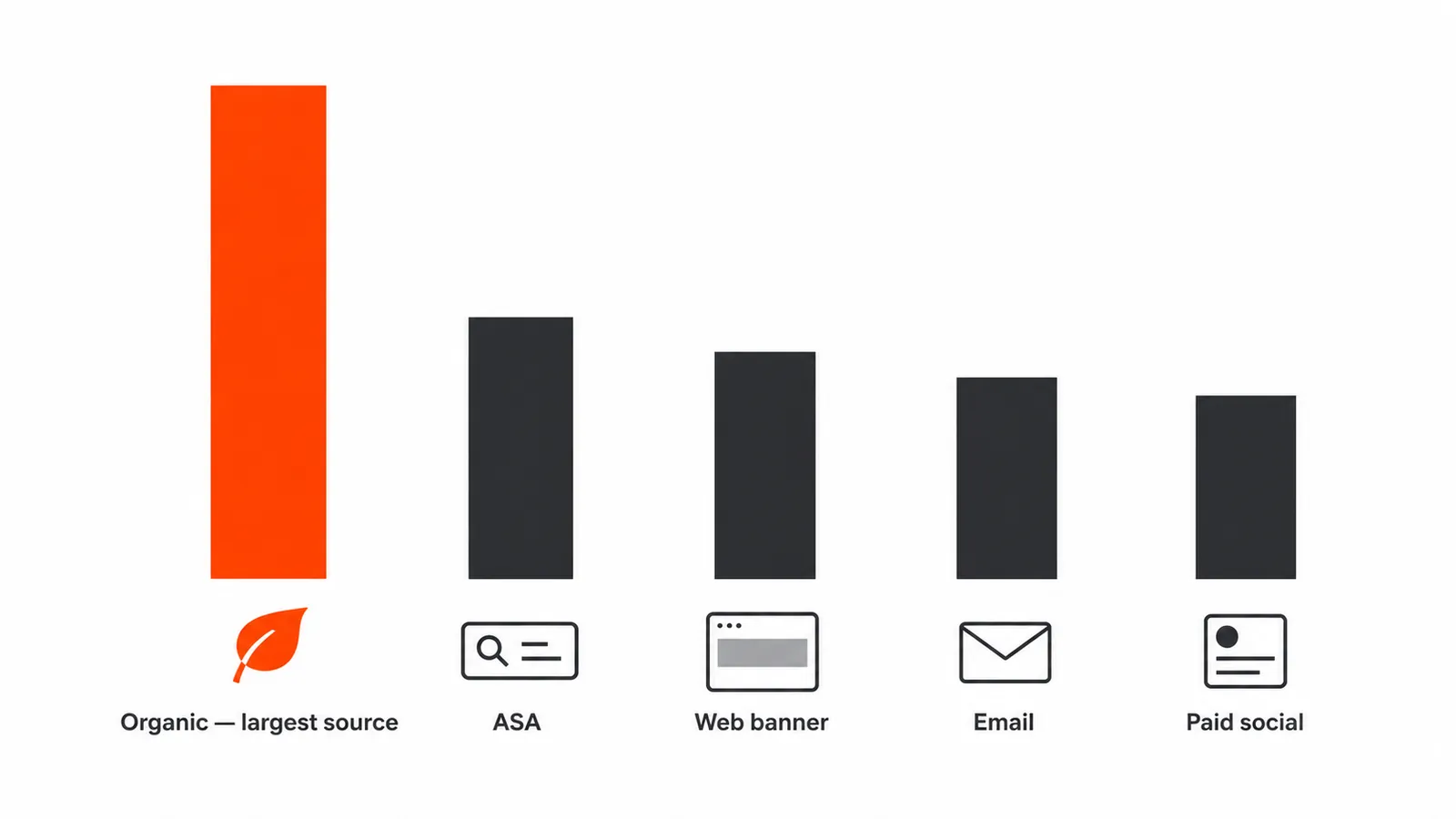
- The clearest proof is the channel mix it reveals. On the app I ran, one month’s in-app purchases split across organic (the single largest source), Apple Search Ads, a web-to-app banner, email, and paid social. A Firebase-only view would have collapsed almost all of that into “organic/direct.”
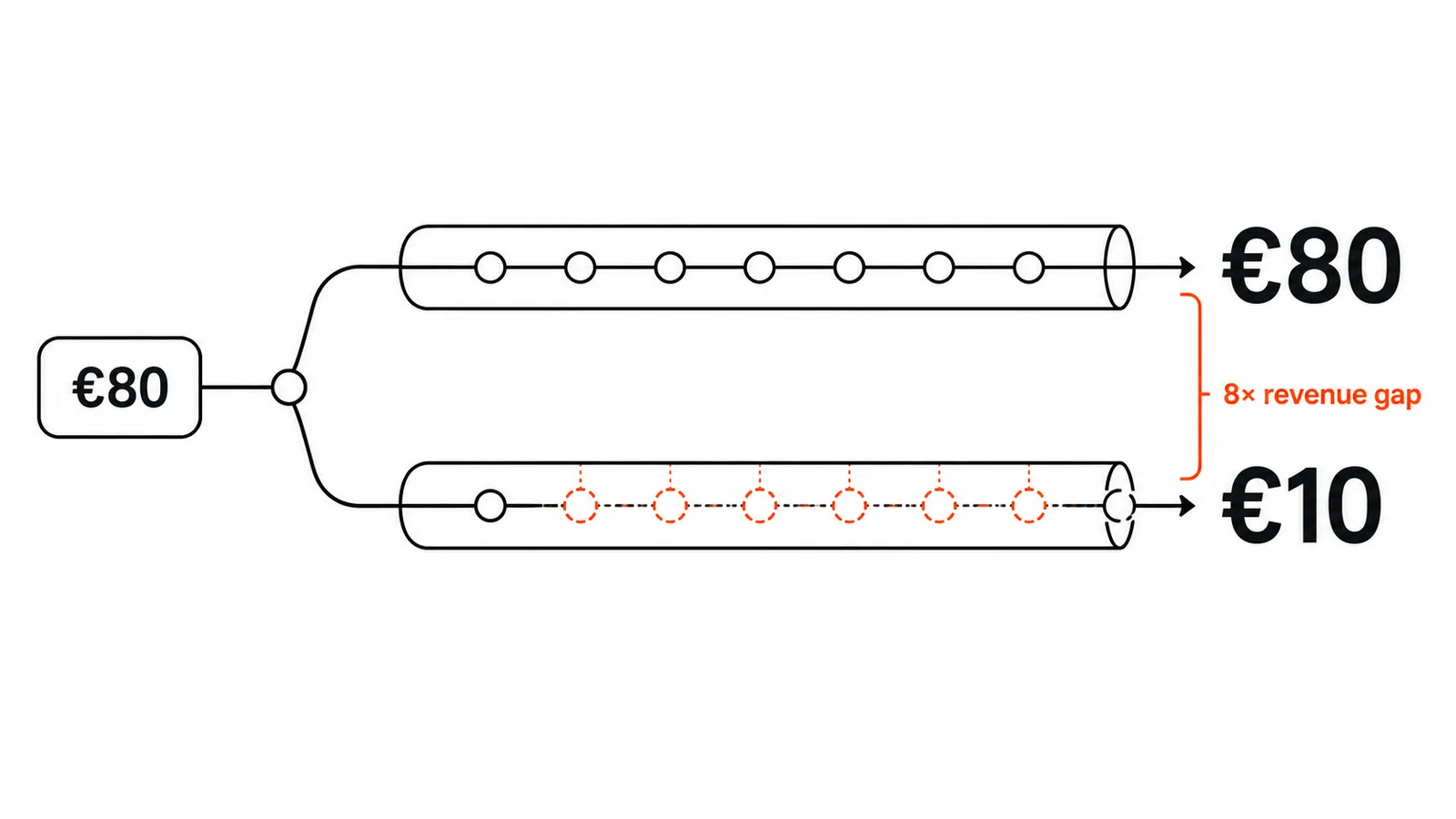
- Run both, as parallel pipelines. In practice they are often separate code paths in your app, and revenue must be set independently in each. One can break while the other works. Ours disagreed on revenue by roughly 8x for a stretch, silently.
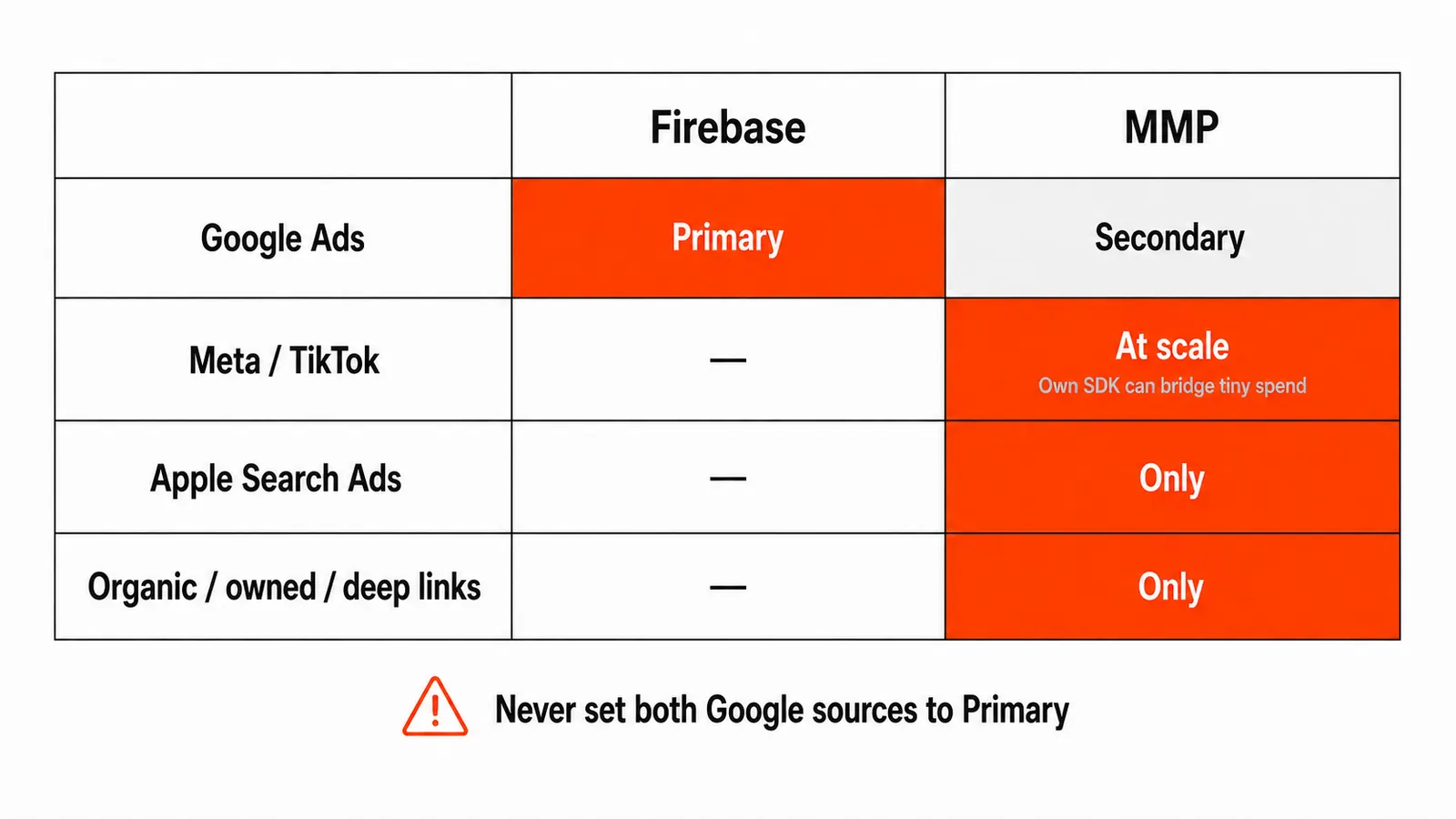
- Decide who feeds what: Firebase as the Primary conversion source for Google Ads (faster, richer signal), the MMP as Secondary there, and the MMP as the only conversion path to Meta and the only honest view of organic and owned channels.
- An MMP is not a day-one requirement for everyone. At tiny Meta or TikTok spend, the platform’s own SDK reports fine on its own. The MMP becomes essential once you scale or run three-plus sources, because that is when it has to deduplicate overlapping claims and attribute every source properly.
- If you skip the source decision, you either double-count conversions or starve a platform of signal. Both quietly ruin bidding.
Why Firebase alone is not enough
Firebase (through GA4) is free, deeply integrated with Google, and genuinely good at what it does: it tracks in-app events, builds audiences, and feeds conversions straight into Google Ads bidding with no extra code beyond the SDK you already installed.
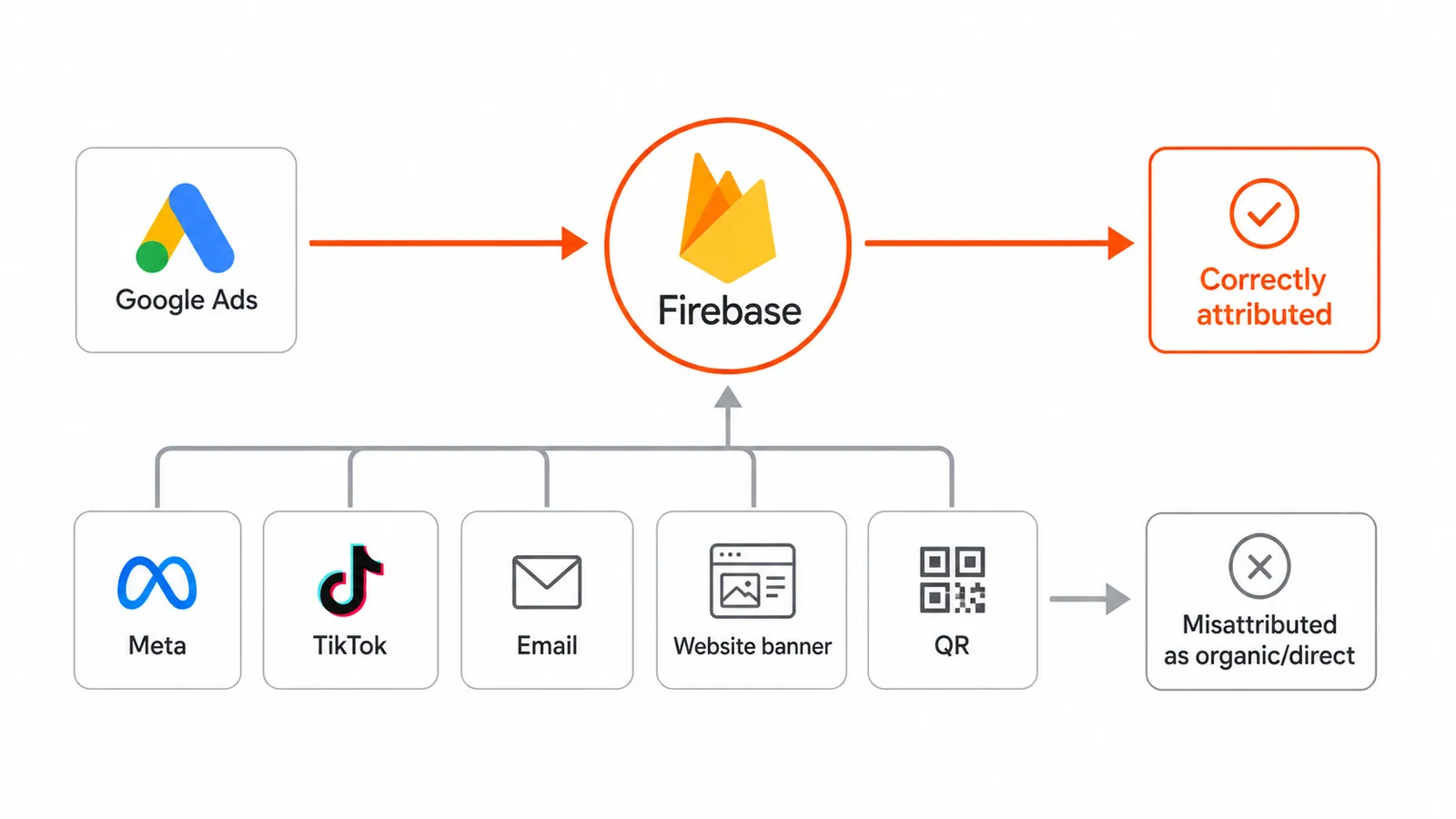
The limitation is structural. Firebase’s attribution connects to Google Ads and essentially nothing else. Run Meta App Ads or TikTok alongside, and Firebase has no view of those clicks. Conversions they drove show up as organic or direct. Practitioner analyses are blunt about it: Meta-driven installs are severely underreported in a Firebase-only setup.
But Meta is only the most obvious blind spot. Firebase is just as blind to Apple Search Ads, to an email campaign that deep-links into the app, to an on-site “get the app” banner, to an offline flyer with a QR code. All of it lands in the same undifferentiated “organic/direct” bucket. If your entire paid budget is Google App Campaigns, Firebase alone is defensible. The moment a second channel matters to you, paid or owned, you are flying blind on it.
What is an MMP, and what does it actually measure?
A mobile measurement partner (MMP) is a third-party attribution platform, such as Adjust, AppsFlyer, Branch or Airbridge, that attributes every app install and in-app event to the source that drove it and reports the result back to each ad network. It sits between your app and the outside world. Every install and in-app event gets attributed to a source, deduplicated across channels, with fraud filtering. Most comparisons stop there and frame the MMP as “the way to measure Meta.” That undersells it. Three jobs matter as much as the paid-network one:
Organic and owned channels become visible. The MMP attributes installs and events that never touched an ad network: App Store browse and search, referrals, your email list, on-site banners, offline QR codes. On the marketplace I ran, the MMP tracked more than ten distinct channels, and organic was consistently the single largest source of in-app bookings, bigger than any paid channel. That is precisely the number a Firebase-only setup cannot give you, because it files organic and everything-not-Google under the same label. You cannot decide whether to invest in ASO, referral, or email if the tool literally cannot see them.
Deep links are an MMP function, not a side effect. The tracking links an MMP issues are also deep links (and deferred deep links): they route a user from an email, an SMS, a web smart-banner, a QR code, or an influencer link to the right place inside the app, even through an App Store install, and attribute the whole journey. This is how owned media actually gets measured. A concrete example: an Instagram channel we ran organically was invisible for months, bucketed as “organic/direct.” The month we added the MMP’s custom tracking links to it, it became a measured source overnight. No new spend, just attribution that finally existed.
One deduplicated cross-channel view. Because every source reports through the same layer, the MMP is the one place a blended, deduplicated picture of the whole funnel exists. It is what you reconcile everything else against.
So “an MMP measures everyone else” is literal. It is the referee for paid networks and the only honest measurement you have for organic, owned, and deep-linked traffic.
One caveat worth stating, because it is the flip side of the same mechanism: an MMP’s attribution is only as good as the links behind it. On our stack, the on-site app banner could not pass the original source through the MMP link, so every install through it was bucketed as “website_banner” with its true upstream source (paid search, Meta, organic) lost. Deep-link and owned-channel measurement is real and valuable, but it has to be wired deliberately, link by link, or it quietly under-credits whatever drove the traffic.
Why an MMP alone is not enough either
If the MMP sees everything, why not use only the MMP? Two reasons, both learned in production:
Google bids better on its own signal. Google Ads accepts conversions from an MMP, but the Firebase path is faster and richer. Firebase events arrive with more granularity and less delay, which matters for tROAS and tCPA bidding. In the account I run, Firebase became the Primary source for Google Ads because the signal was simply better.
The MMP pipeline has more moving parts. In our build, Firebase events went directly from the app via the Firebase SDK, while the MMP received events through a customer data platform (RudderStack) that mapped them to the Adjust SDK. Two code paths, two places to set revenue, two failure surfaces. More on what that cost us in part two, but the architectural point stands: the MMP path is rarely the simple one.
The dual-stack architecture
Here is the shape that works, and that I would build again:
App events
  ├── Firebase SDK (direct)
  │     └── GA4 → Google Ads          (Primary for Google)
  └── CDP or direct → MMP SDK (Adjust)
        ├── → Meta (S2S postbacks)     (ONLY path to Meta)
        ├── → Google Ads               (Secondary, cross-check)
        ├── → TikTok / Apple Search Ads / others
        └── → organic, email, banner, QR / deep links  (attribution + routing)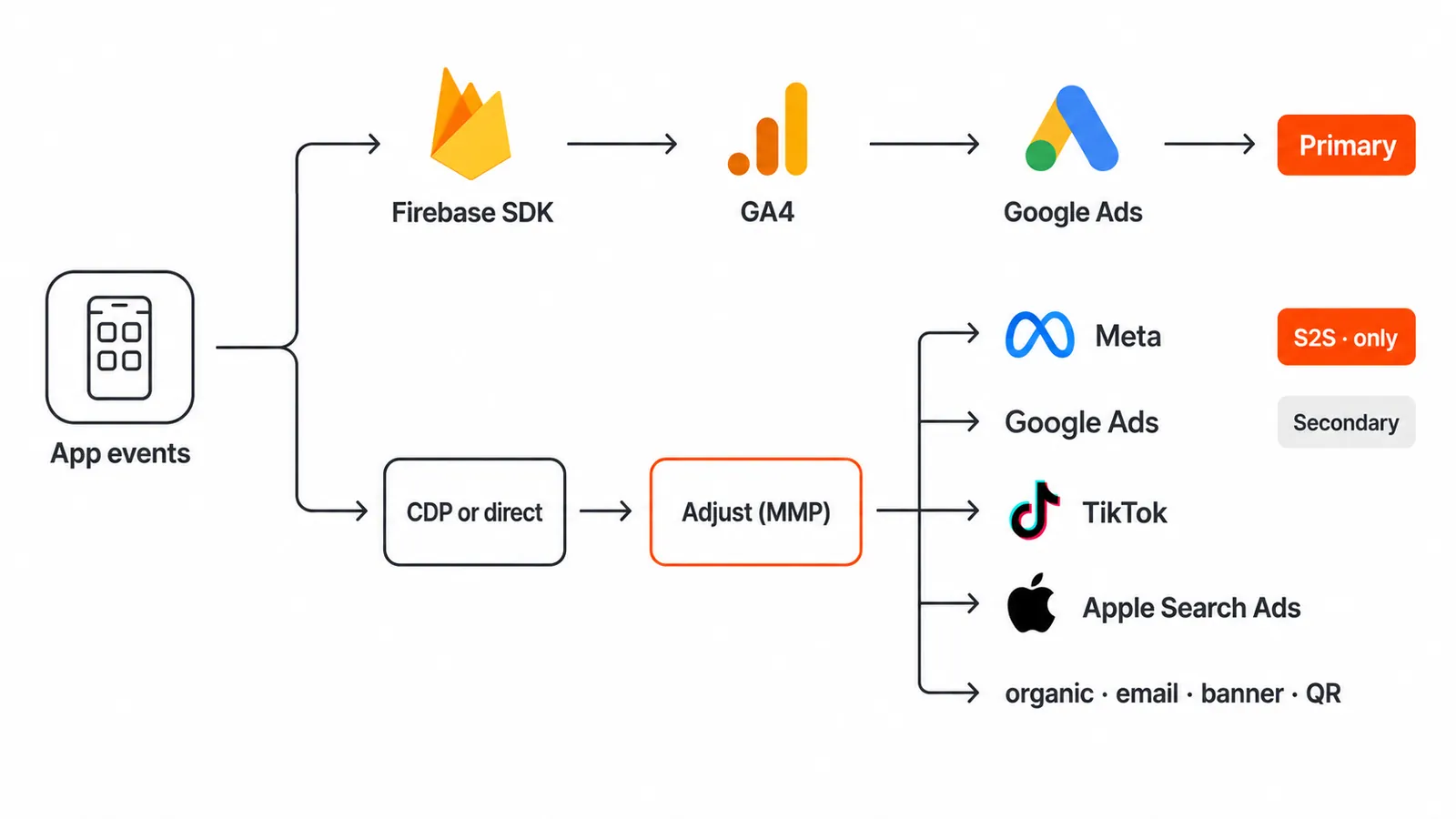
Three properties of this setup matter more than any tool choice:
1. The pipelines are independent. Firebase and the MMP do not share state. An event can carry revenue in one and arrive without it in the other. Treat them as two separate products that happen to describe the same user.
2. Revenue is set twice, deliberately. The Firebase call and the MMP call each need the value and currency attached explicitly. Assuming one inherits from the other is the single most expensive assumption in app tracking. On our stack, the two pipelines disagreed on captured revenue by roughly 8x for a stretch. One pipeline attached values correctly while the other silently dropped them, and nothing errored. The fix was code-level, in one pipeline only. (The full autopsy is part two.)
3. Each platform gets its best available source. Which brings us to the decision most teams never make explicitly.
Who feeds what: the operating decision
This is the part the tool comparisons skip, and it is the part that decides your bidding quality.
Google Ads: Firebase as Primary, MMP as Secondary. Import both, but mark the Firebase conversion actions as Primary (used for bidding) and the MMP’s as Secondary (observation only). You get Google’s fastest signal for Smart Bidding plus an independent cross-check from the MMP. Never set both to Primary: Google will count the same purchase twice, and your reported CPA will look better than reality while bidding optimizes toward a fiction.
Meta and other networks: the MMP, full stop. Firebase does not talk to Meta. The MMP’s server-side postbacks are your only clean conversion path for App Ads, including the revenue values Meta needs for value optimization. The same is true for TikTok and Apple Search Ads. This also means their signal quality is only as good as your MMP pipeline, which is exactly where ours was silently losing revenue. One exception, at the very start: below trivial spend, Meta’s and TikTok’s own SDKs can report their events directly, which is why adding the MMP is really a scaling decision (more on the timing below).
Organic, owned, and deep-linked channels: the MMP is the only source. There is no Firebase equivalent for “how many bookings came from the email deep link, the on-site banner, or organic.” If you want to make ASO, referral, or CRM decisions with data instead of vibes, this is where it comes from.
Reporting: GA4 for behavior, the MMP for cross-channel attribution, your backend for truth. Three numbers that will never perfectly agree, and do not need to. What they need is to reconcile within a tolerance you have decided in advance. When app revenue in the MMP is a fraction of what the backend shows, that is not an attribution philosophy problem. That is a bug.
When to add the MMP
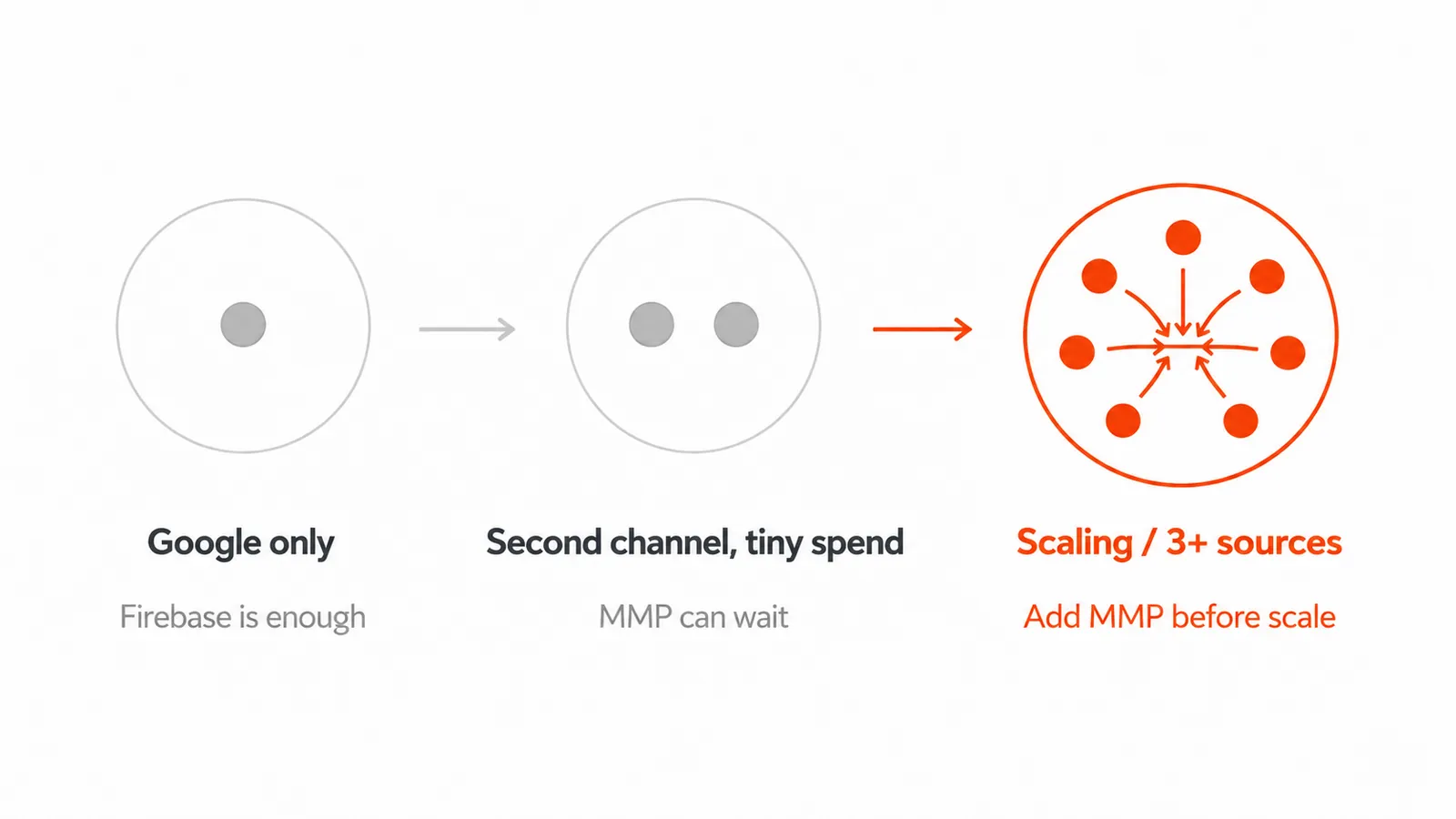
Sequence it by spend, not by ambition, and be honest about your stage. An MMP is not a day-one requirement for every app.
- Google-only, small budget: Firebase alone is fine. Set it up properly (events, values, conversions imported) and skip the MMP fee.
- A second channel, but tiny spend: you can defer the MMP here too. Meta and TikTok both have their own SDKs that report app events straight to each platform, and at a few hundred euros a month that is enough to optimize a single channel. The catch is that each platform self-attributes in isolation, so nothing deduplicates and you have no single, honest cross-channel view. At trivial spend that gap is tolerable. Just know it is a stopgap, not the destination.
- Scaling, or three-plus sources: now the MMP is the answer, and this is the reason it exists. Once real budget flows across Google, Meta, TikTok, plus organic and owned channels, the platforms start claiming the same install and the same purchase, and your numbers inflate. The MMP is the layer that deduplicates every event to one source of truth and attributes each install and conversion to the source that actually earned it. Add it before you scale, not after, because retroactive attribution does not exist: whatever runs before the SDK ships is unmeasurable forever.
- At scale it keeps paying off: cohort exports, fraud filtering, deep-link routing for lifecycle campaigns, and SKAdNetwork management on iOS.
MMP pricing typically scales with attributed installs or events. For an early-stage app the entry tiers are modest against even a small paid budget, and once you are scaling, the alternative, buying installs you cannot attribute and letting every platform double-count, is more expensive than any tool.
Common mistakes
- Treating the MMP as a replacement for Firebase on Google. You lose Google’s best bidding signal and gain nothing.
- Treating the MMP as “just the Meta pipe.” You paid for cross-channel, organic, and deep-link measurement. Use it. The channel it makes visible might be your biggest one.
- Both sources set to Primary in Google Ads. Double-counted conversions, flattering dashboards, corrupted bidding.
- Assuming revenue flows to both pipelines because the event does. Event names arriving is not the same as values arriving. Verify each pipeline separately.
- Adding the MMP after the campaigns launched. Attribution starts when the SDK ships, not when you signed the contract.
- Nobody owns the mapping. Web events, Firebase events, and MMP events need one documented mapping (which app event equals which conversion on which platform, and which deep link feeds which channel). Without it, every debugging session starts from zero.
FAQ
What is an MMP (mobile measurement partner)?
An MMP is a third-party attribution platform, such as Adjust, AppsFlyer, Branch or Airbridge, that you add to your app as an SDK. It attributes every install and in-app event to the source that drove it, across paid networks, organic and owned channels, deduplicates overlapping claims, filters fraud, and sends conversions back to each network server-side.
Is Firebase an MMP?
No. Firebase (with GA4) is an analytics SDK whose attribution connects to Google Ads and little else. It cannot attribute Meta, TikTok or your owned channels the way an MMP does, which is why most scaling apps run both.
Why don’t my Firebase and Adjust revenue numbers match?
Usually because revenue is set separately in each pipeline, and one of them is dropping values or falling back to defaults. Part two of this series walks through the five silent failures that cause it and the checks that catch each one.
Is GA4 the same thing as Firebase for app tracking?
Effectively yes for this discussion: the Firebase SDK feeds GA4, and Google Ads imports the conversions from there. The pair is one pipeline.
Which MMP should a startup pick?
Adjust, AppsFlyer, Branch, and Airbridge all cover the core job. Pick on pricing model, the networks you actually use, deep-linking needs, and SDK fit with your stack. The architecture in this post applies to all of them.
Can I send Firebase data to Meta somehow?
Not usefully. Meta’s app attribution runs on its SDK or on MMP server-side postbacks. This is precisely why the MMP earns its place the day Meta gets budget.
If most of our installs are organic, do we still need an MMP?
That is the strongest case for one, not against. Firebase cannot tell organic apart from Meta, email, or a web-to-app banner. It files them together. If organic is your biggest source, an MMP is the only way to confirm that, protect it, and grow it (ASO, referral, deep-linked lifecycle campaigns) with real data.
Do the two pipelines double-count revenue in my reporting?
Only if you blend them. Keep Google Ads deduplicated via Primary/Secondary, and treat GA4, the MMP, and your backend as three views with known, expected gaps.
What about iOS and SKAdNetwork?
iOS adds a third measurement layer (SKAN/AdAttributionKit) on top of both pipelines, plus the gBraid mechanics for web-to-app campaigns. That is part three of this series; the short version is that iOS attribution fails in ways Android never shows you.
Key takeaways
- Firebase measures Google; an MMP measures everything else: paid networks, and just as importantly organic, owned channels, and deep links. Both, in parallel, is the standard answer once more than one channel matters.
- The MMP is not just the Meta pipe. On a real app, its most valuable output was seeing that organic, invisible to Firebase, was the single largest source of bookings.
- The pipelines are independent code paths. Revenue must be set explicitly in each, and one can break while the other works.
- Make the source decision explicit: Firebase Primary for Google Ads, MMP Secondary there, MMP exclusively for Meta and for organic/owned/deep-link measurement.
- Reconcile the three views (GA4, MMP, backend) on a schedule, with a tolerance. Disagreement beyond it is a bug, not a philosophy.
Next in the series: the five silent failure modes I shipped on this exact stack, and the monitoring checklist that would have caught each one earlier.
Getting this stack clean settles which source to credit for an install. It does not tell you whether the ad actually caused it, which is a separate question worth understanding before you pour budget into a channel. If you are wiring this up now, or you suspect a pipeline is quietly dropping revenue the way ours did, check it before you scale, because you should not bid on numbers you cannot trust yet. A full app tracking audit will tell you which of these two groups you are in, and if you would rather just get a second opinion first, I am happy to sanity-check your setup.
Sources: Google Ads Help, importing app conversions from Firebase and App Attribution Partners; AppSprint, Firebase vs MMP; AppsFlyer on measuring Google App Campaigns; Adjust on deep linking and deferred deep linking; first-party implementation experience on a dual Firebase + Adjust stack (2026).