


Every iOS app team asks the same question once ATT settles in: do we still need a mobile measurement partner, or does SKAdNetwork handle attribution now? It usually gets framed as a choice, SKAN or an MMP, as if you pick one. That framing is wrong, and the mistake is expensive.
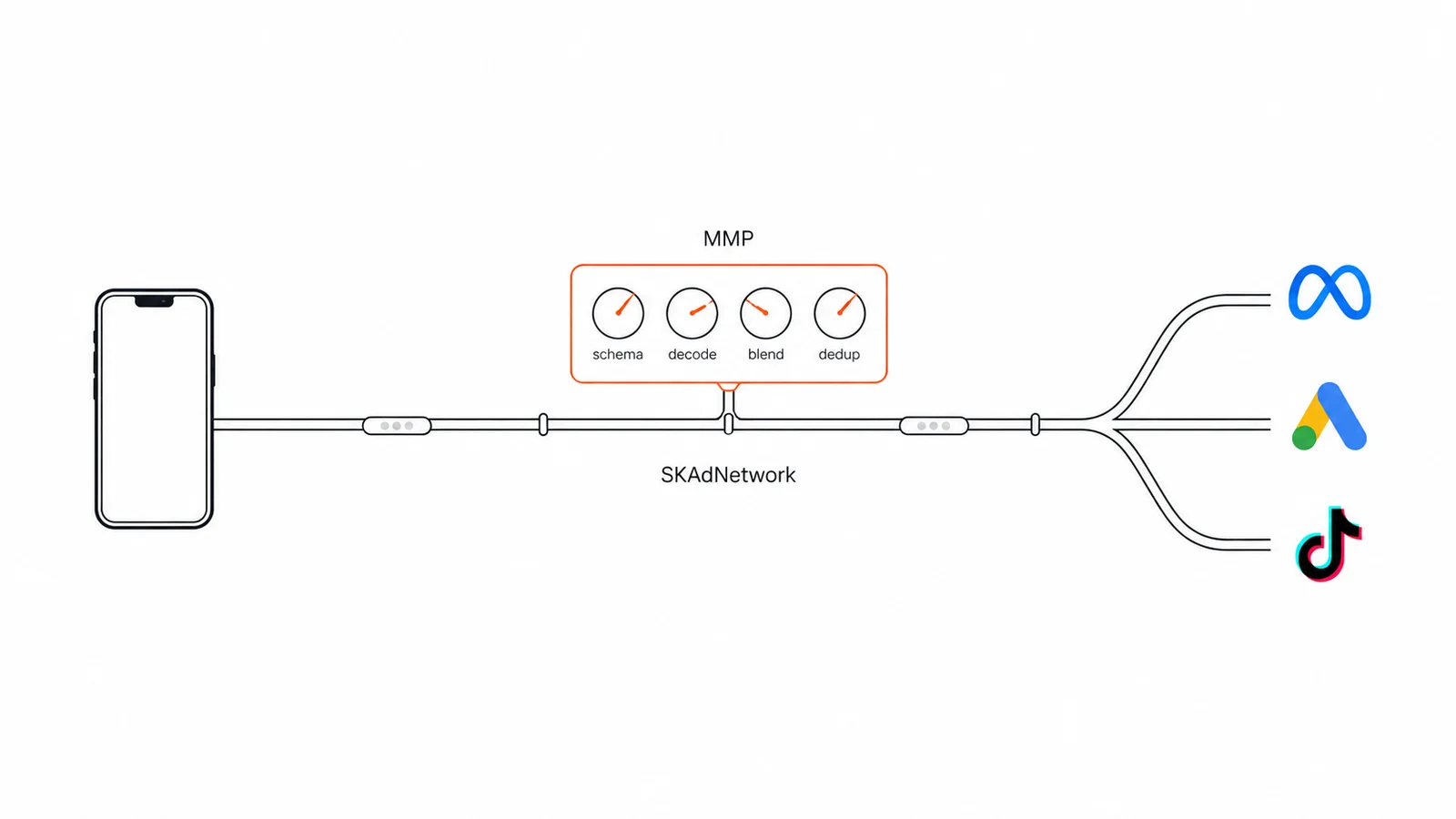
SKAdNetwork (SKAN) is not a tool you choose. It is Apple’s privacy layer, and every ad-driven install from a user who declined tracking is measured through it whether you like it or not. An MMP does not replace SKAN. It runs on top of it: it owns your conversion-value schema, decodes the postbacks, and blends SKAN with the deterministic and modeled data around it. So the real question is not “SKAN or MMP.” It is “do I need the layer an MMP adds on top of SKAN?” That answer depends on your scale and how many networks you run, and this post walks through it.
I ran exactly this stack for a Swiss booking marketplace: SKAN and AdAttributionKit underneath, Adjust as the MMP on top, feeding Google, Meta and the rest. Most of what follows I learned configuring the part almost nobody enjoys, the conversion-value schema.
This follows the app-tracking series. Part one covered why you run Firebase and an MMP in parallel; part two covered how that stack breaks silently. This one is the iOS-specific layer: what SKAN changes, and whether the MMP still earns its place once Apple’s privacy framework sits between you and the truth.
TL;DR
- SKAdNetwork (and its successor AdAttributionKit) is Apple’s privacy substrate. Every ad-driven install from an opted-out user is measured through it. You do not opt in or out of SKAN; you opt in or out of an MMP.
- An MMP does not replace SKAN. It sits on top: it manages your conversion-value schema, decodes and maps the postbacks, and blends SKAN with consented (IDFA) deterministic data and modeled data into one cross-network view.
- The real decision is “do I need an MMP,” sequenced by scale, exactly like the Firebase-or-MMP call. Single network at small spend: the network’s own SKAN handling is enough. Multiple networks or real budget: the MMP earns its place.
- The clincher: you get one SKAN conversion-value schema per app, shared across every network. At multi-network scale someone has to own that single schema centrally. That is the MMP’s job, and doing it by hand is where teams quietly corrupt their iOS data.
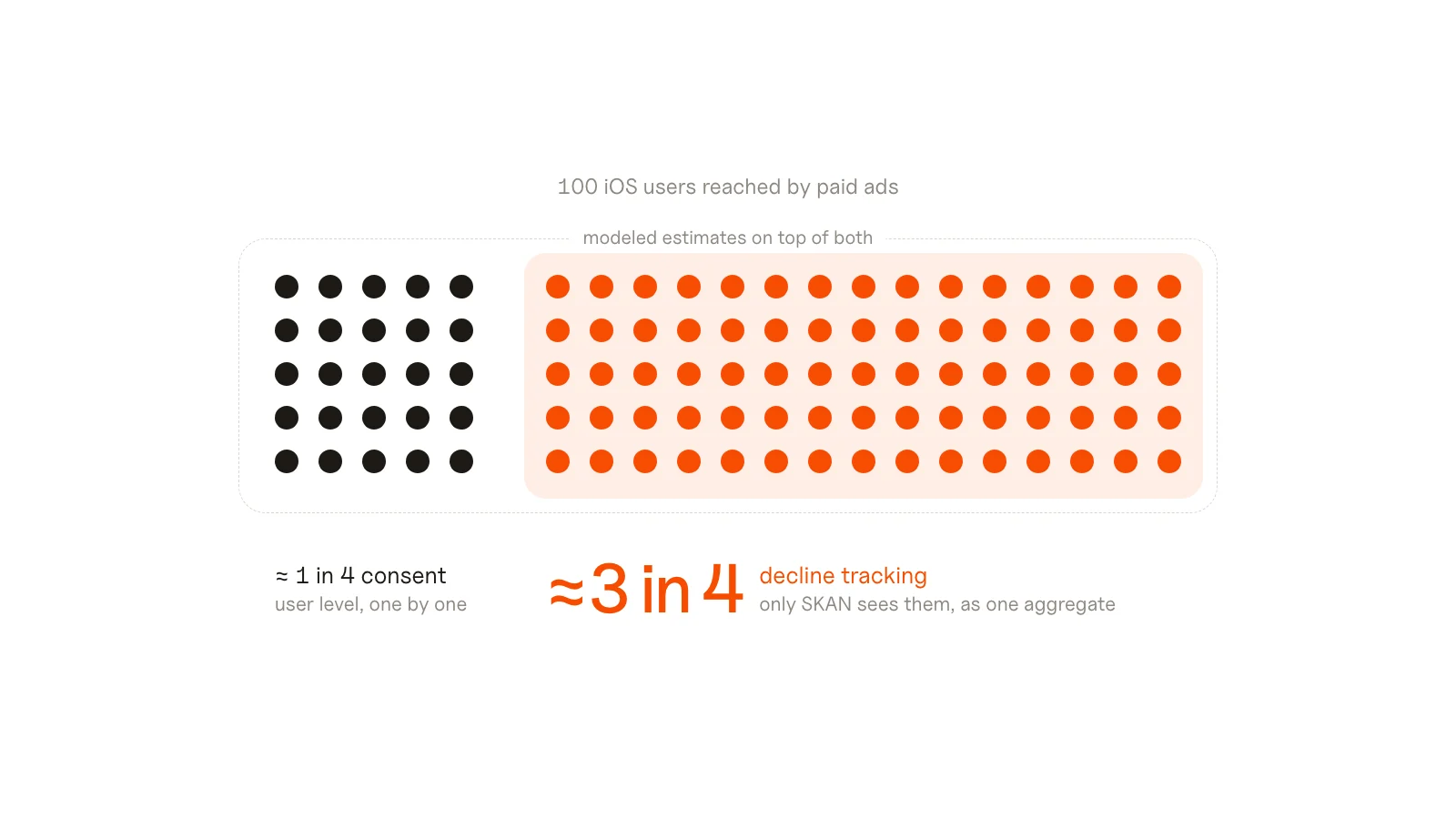
- iOS measurement is always a blend of three populations: the roughly one in four who consent (deterministic), the rest via aggregated SKAN, and modeled estimates on top. Anyone selling you one true iOS number is selling you a fiction.
What SKAdNetwork actually is (the substrate)
SKAdNetwork is Apple’s framework for attributing app installs without exposing the individual user. When someone taps an ad and installs, the device, not your SDK, sends a signed postback to the ad network. The postback carries a campaign identifier and a conversion value you defined, and nothing that identifies the person.
Three properties shape everything you can do with it:
- It is aggregated and thresholded. Apple applies a privacy floor it calls crowd anonymity. Below a certain install volume it strips the conversion value or the campaign detail, so small campaigns come back as “an install happened” with no signal about what it was worth.
- It is coarse and delayed. SKAN 4 gives you a fine conversion value (6 bits, 0 to 63) plus coarse buckets (low, medium, high) across a few postback windows that can stretch to 35 days. You are encoding a user’s early value into a handful of bits, on a timer, not streaming events in real time.
- It is the default, not the exception. Since roughly three in four iOS users decline ATT, SKAN is how most of your paid iOS installs get measured. AdAttributionKit, introduced in 2024, is Apple’s successor: same privacy model, plus re-engagement and alternative-marketplace support. Both send the same style of postback.
The key point for this decision: every ad network already receives SKAN postbacks directly. Meta, Google and TikTok all ingest SKAN and show you SKAN campaign data in their own dashboards. So at the most basic level, you already have SKAN attribution with no MMP at all.
What an MMP actually does on iOS (and it is not “instead of SKAN”)
If the networks already get SKAN, what is the MMP for? On iOS it does four jobs, and none of them is “replace SKAN.”
It owns the conversion-value schema. SKAN gives you a tiny budget of bits to describe a user. Deciding what those bits mean (revenue buckets, a funnel step, a predicted-LTV tier) and updating that mapping as the app changes is the hard part. The MMP gives you the interface and logic to design that schema and push it to the SDK. This is the single most valuable thing it does.
It decodes and maps the postbacks. The MMP turns the encoded conversion value back into your event language and maps the source identifier to a real campaign, so “conversion value 37 from source 1234” becomes “trial started, from the summer campaign.”
It blends the three attribution modes. For the users who consent, the MMP does deterministic IDFA attribution. For the rest it uses SKAN. On top it layers modeled attribution. It reconciles those into one view instead of three contradictory ones.
It deduplicates across networks. SKAN postbacks land with each network separately, and each network claims what it can. The MMP is the one place a deduplicated, cross-network picture exists.
The clean mental model: SKAN is the pipe Apple forces every install through; the MMP is the control panel and the reconciliation layer on top of that pipe. You are never choosing between them.
The one-schema problem (this is the crux)
Here is the fact that decides most of this, and that the “SKAN vs MMP” framing hides completely: you get one SKAN conversion-value schema per app. Not one per network. One, shared across Meta, Google, TikTok and every other network at once, because the schema lives on the device and the OS, not inside any single ad platform.
That changes the question entirely. Run a single network and you can let that network define the schema in its own tooling and be done. The moment you add a second network, both are reading the same 64-value schema, and someone has to own it centrally so it means the same thing to all of them. You can hand-manage that. In practice, hand-managing one shared conversion-value schema across several networks, and keeping it current as the app changes, is exactly where teams corrupt their iOS data without noticing. This is the job the MMP exists to do.
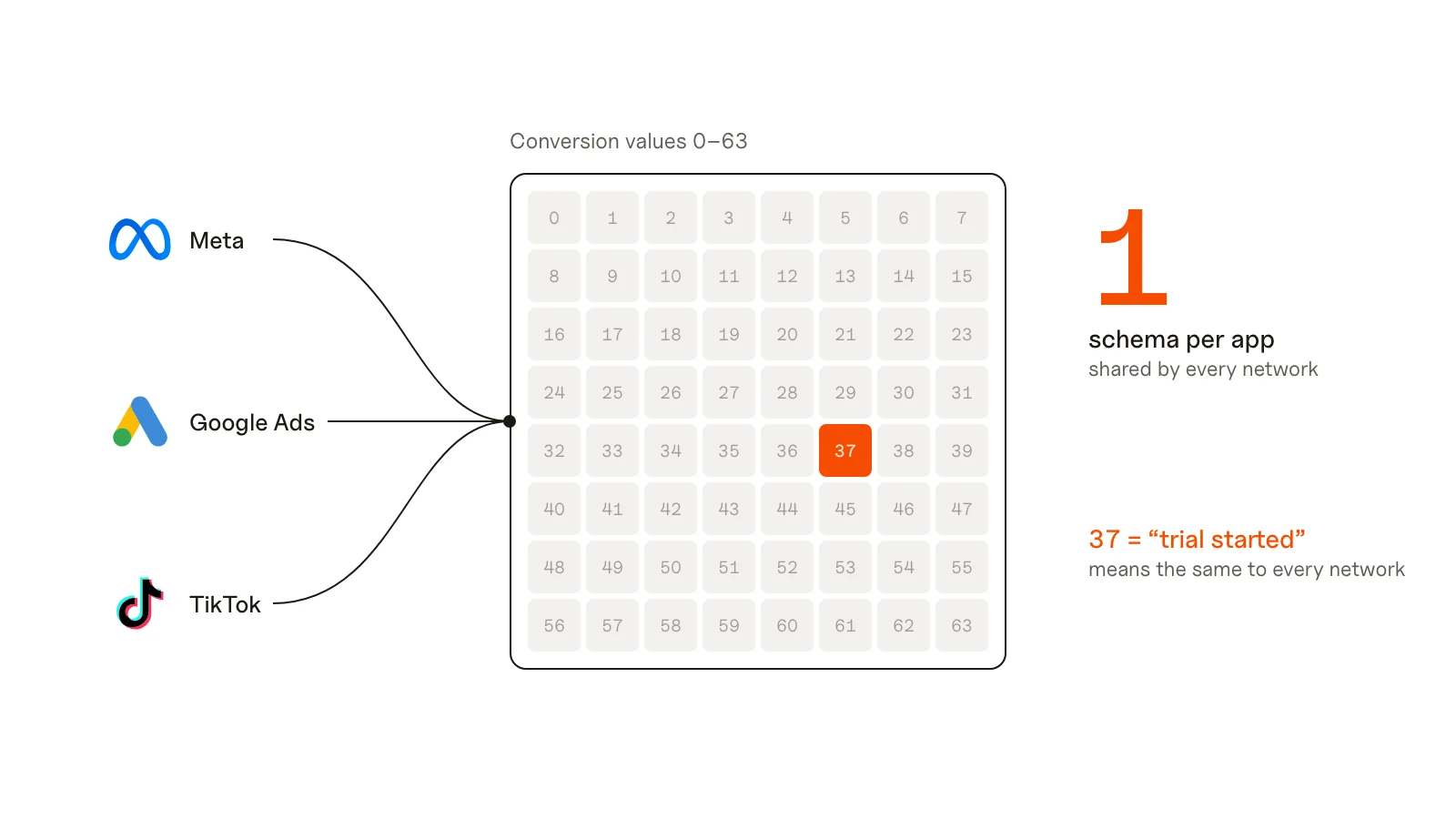
So the one-schema problem is really the answer to “do I need an MMP.” Here is how it sequences.
So, do you need an MMP for iOS?
Sequence it by scale and network count, the same way you would decide on an MMP at all (see part one).
- One network, small spend. You do not need an MMP for iOS yet. Meta or Google will manage the SKAN schema in their own console and report SKAN campaign data. Set it up properly and skip the fee.
- Two or more networks, or scaling spend. Now the one-schema problem bites, and the MMP earns its place: one owner for the shared conversion-value schema, cross-network dedup, and the deterministic-plus-SKAN-plus-modeled blend in a single view. This is the same threshold as the general “add the MMP once you run three-plus sources” rule.
- Subscription or high-value apps. If your economics live in trial-to-paid and renewal, your entire iOS measurement rests on mapping early signals to predicted value inside those few SKAN bits. That schema work is the game, and it is exactly what the MMP’s tooling is built for. If you sell subscriptions on iOS and run paid, this is not optional.
Common mistakes
- Treating SKAN and the MMP as an either/or. They operate at different layers. The MMP consumes SKAN; you cannot pick one instead of the other.
- Letting each network manage its own conversion value. There is only one schema per app. Two networks defining it independently will fight, and your values stop meaning anything.
- Expecting user-level iOS numbers. SKAN is aggregate and thresholded by design. Per-user revenue on opted-out iOS does not exist.
- Stuffing raw revenue into the conversion value. The fine conversion value is a 6-bit code (64 values, 0 to 63), not a money field: the postback returns an integer like “37,” and you decide what it means. You bucket revenue into ranges, or map it to a predicted-LTV tier; you cannot pass a raw amount like 150€, because the code has no way to represent it.
- Reading SKAN, deterministic and modeled as one clean number. They measure different populations with different methods. Reconcile them within a tolerance; do not expect them to match.
- Adding the MMP and its schema after launch. Attribution starts when the SDK and the conversion-value schema ship, not when you sign the contract. Whatever ran before is unmeasurable forever.
FAQ
Does an MMP replace SKAdNetwork?
No. SKAdNetwork is Apple’s privacy layer that every ad-driven install from an opted-out user passes through; you cannot route around it. An MMP runs on top of SKAN: it manages your conversion-value schema, decodes the postbacks, and blends SKAN with consented and modeled data. It makes SKAN usable, it does not replace it.
Can I just use SKAN without an MMP?
Yes, at small scale or on a single network. Meta, Google and TikTok each ingest SKAN and expose SKAN campaign data in their own dashboards, and they can manage the conversion-value schema for you. The MMP earns its place once you run multiple networks, because you get only one shared schema per app and someone has to own it centrally.
What is the difference between SKAdNetwork and AdAttributionKit?
AdAttributionKit is Apple’s successor to SKAdNetwork, introduced in 2024. It keeps the same privacy model and postback style, and adds re-engagement and alternative-marketplace attribution. An MMP consumes both, so the decision in this post does not change.
Why does iOS report far fewer conversions than I know happened?
Because roughly three in four users decline tracking, so most installs are measured through aggregated SKAN, and Apple’s privacy thresholds remove detail on smaller campaigns. You are not missing a setting; you are seeing a blend of consented deterministic data, aggregated SKAN, and modeled estimates. Reconcile them against your backend rather than trusting any one of them alone.
If most of my installs are organic, do I still need an MMP?
Possibly, but for a different reason. SKAN only covers ad-driven installs. Organic and owned-channel attribution (App Store search, referrals, email, deep links) is an MMP job, not a SKAN one. That is the argument from part one: if organic is your biggest source, the MMP is how you see it at all.
Key takeaways
- SKAdNetwork is the substrate, not a competitor to the MMP. Every opted-out iOS install is measured through it.
- The MMP is SKAN’s control panel: it owns the conversion-value schema, decodes the postbacks, blends the three attribution modes, and deduplicates across networks.
- You get one conversion-value schema per app, shared across every network. At multi-network scale, owning that one schema is on its own a reason to run an MMP.
- The real decision is MMP or not, sequenced by scale, not SKAN versus MMP.
- iOS measurement is always a blend of consented, SKAN and modeled data. Distrust any single “true” iOS number.
If you are running paid on iOS and your SKAN conversion values, your consented data and your backend do not line up, that gap is usually the schema, not bad luck. A full app tracking audit will tell you whether your iOS setup measures what you think it does, and whether you have outgrown letting each network manage SKAN on its own.
The companion piece in the series covers the iOS gap in Google Ads specifically: why it can read close to zero app conversions even when iOS is outselling Android, and the gBraid fix.
Sources: Apple, SKAdNetwork documentation; Apple, AdAttributionKit; Adjust, SKAdNetwork explained; AppsFlyer, understanding the SKAdNetwork conversion value; first-party implementation experience on a SKAN + AdAttributionKit + Adjust stack for a Swiss booking marketplace (2026).