



Google Meridian is Google’s open-source marketing mix model (MMM): a Bayesian model that estimates how much each channel contributes to sales from aggregate spend and outcome data, with no user-level tracking. It is free and generally available since January 2025. The catch is everything around it: the data it needs, the statistics it assumes, and the calibration that makes its answer trustworthy.
This post covers what Meridian actually takes to run, and what a growing brand should run at each stage instead, because for most brands the right first step is not an MMM at all.
TL;DR
- Marketing-mix modeling (MMM) used to cost 150.000€ to 500.000€. In 2026 the models are free: Google’s Meridian and Meta’s Robyn are both open-source.
- The tool was never the hard part. Running one well needs Python, Bayesian statistics, and two to three years of varied spend data.
- MMM is gated by data maturity, not revenue. A fast-growing 3M€ brand should not be building one.
- Incrementality (geo-lift and holdout tests) is the mid-market on-ramp, now that Google cut its lift-test minimum from roughly $100,000 to $5,000.
- No single number is the truth. Attribution is directional, incrementality is causal, MMM is strategic. Run the three so they check each other.
What is Google Meridian, and why “free” is not the win
Marketing-mix modeling used to mean a six-figure consulting project and a data-science team. The legacy engagements ran 150.000€ to 500.000€ over roughly six months, and only Fortune 500 budgets could carry them.
That barrier is gone. In 2026 the models are free. Google’s Meridian and Meta’s Robyn are both open-source: Robyn since 2021, Meridian generally available since January 2025, with a no-code Scenario Planner added in early 2026.
So the tool is no longer what mid-market D2C brands are missing. What they are missing is someone who can actually run it.
That distinction is the whole game. I covered the foundation layer, the startup-sized tracking stack itself, in enterprise measurement without the enterprise. This post is about what you run on top of that stack, and when. Below is the ladder, stage by stage, and why “free” is not the same as “easy.”
Why measurement swung back to modeling
Apple’s ATT prompt and the slow retirement of the third-party cookie broke user-level tracking. The methods that survived are the ones that never depended on it.
MMM and incrementality both read aggregate spend against aggregate outcomes. No cookies, no device IDs, no stitching individual journeys together. That privacy-durability is why they came back into fashion.
Marketers noticed. In a July 2025 eMarketer and TransUnion survey of 196 US brand and agency marketers, MMM was the single most-trusted measurement method at 27.6%, ahead of multi-touch attribution at 19.4% and unified approaches at 18.9%. Nearly half, 46.9%, plan to invest more in MMM over the next year, and more than half, 52%, already run incrementality tests.
One honest caveat before you get excited: adoption is running ahead of confidence. TransUnion found that marketers’ trust in their own measurement has actually stalled. That is a reason to get this right, not a reason to chase the headline.
”Free” is not “easy”
Meridian is a Bayesian model. It wants Python, a GPU, and a level of statistical literacy most marketing teams simply do not have. The model is free. The person who can run it is not.
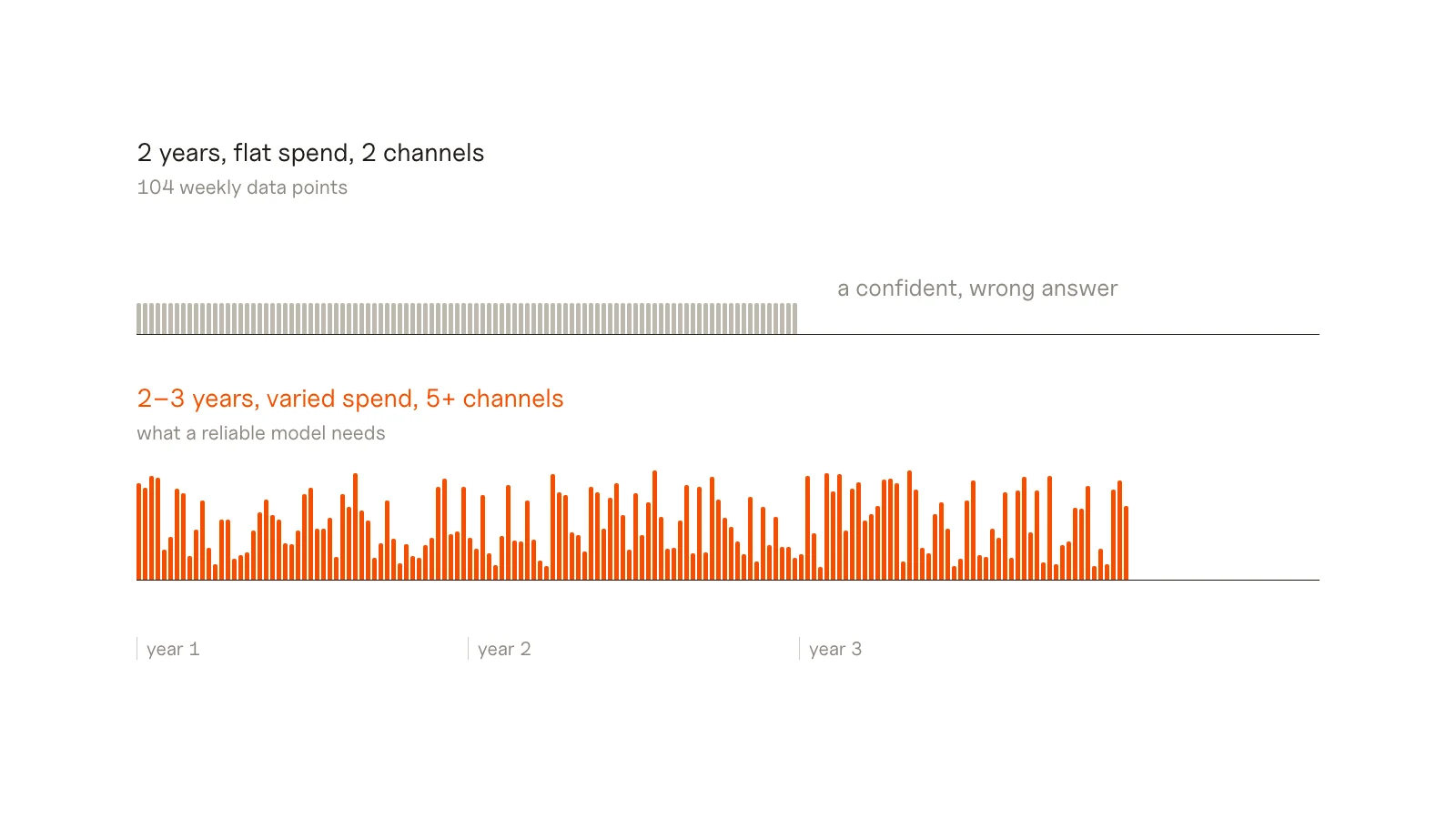
It is also data-hungry. A reliable model needs roughly two to three years of weekly data with genuine spend variation across five or more channels. Google’s own Meridian documentation is blunt about it: two years of weekly data (104 data points) against about 26 parameters is “too low to estimate the model reliably,” and it recommends closer to 15 data points per parameter, which is around three years of history.
So two years of flat spend on the same two channels does not give you an MMM. It gives you a polished, confident, wrong answer. A spreadsheet of blended ROAS is not a model input.
This is the correction most “just run an MMM” advice gets wrong. MMM is gated by data maturity, not revenue. A fast-growing 3M€ brand should not be building one. Its entry point sits one rung lower.
Three methods that check each other
The honest setup for a growing D2C brand is not one source of truth. It is three that keep each other honest.
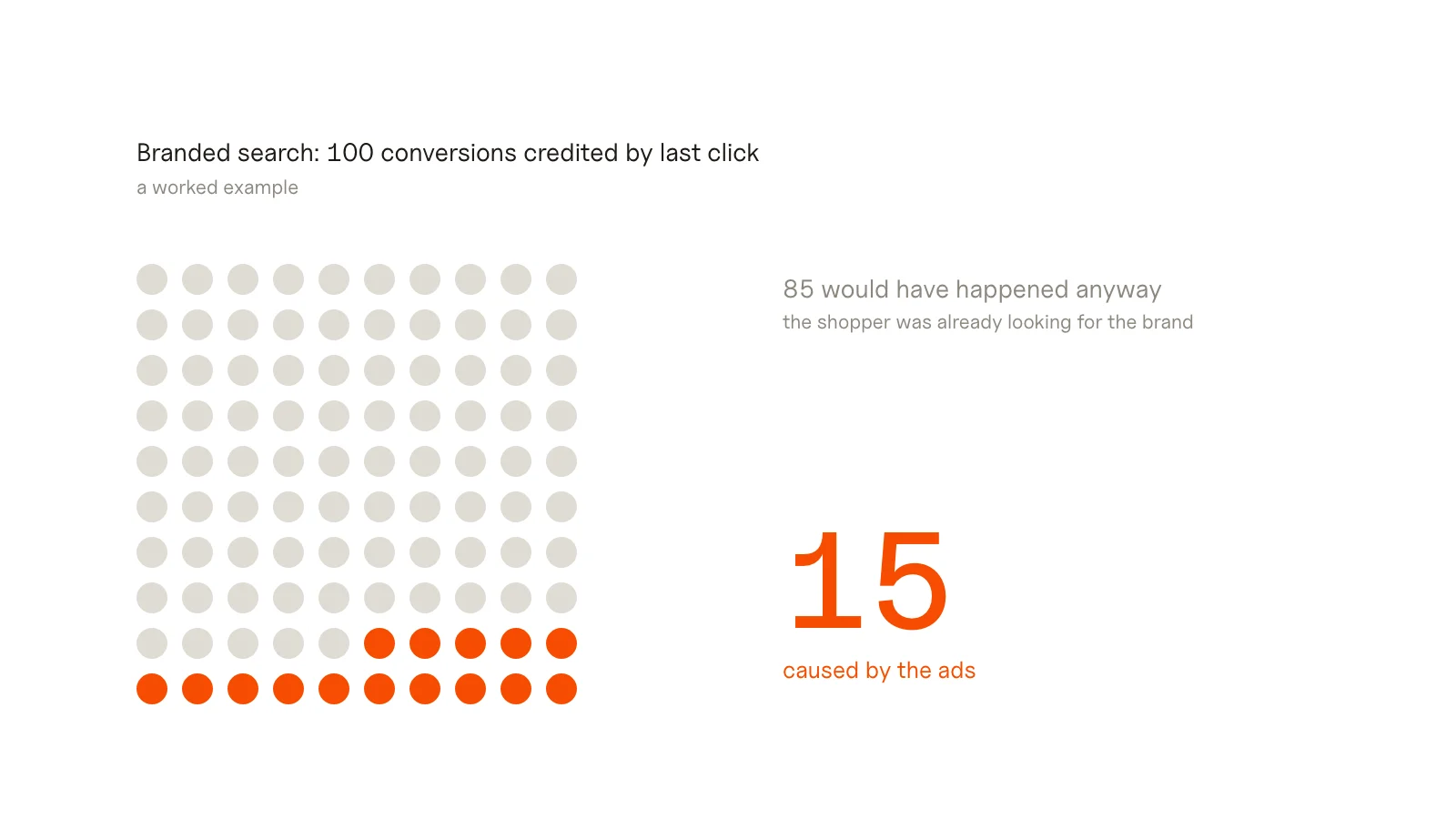
Platform attribution. Daily and in-flight, useful for optimization, but directional rather than gospel. It hands your branded search a beautiful last-click ROAS. Run a proper holdout and you usually find 70 to 90% of those conversions would have happened anyway. In one common worked example, 85% were non-incremental. The dashboard was not lying on purpose. It just cannot see the counterfactual, what would have happened without the spend. This is also why Google Ads retired its rule-based attribution models in favour of data-driven attribution, and why multi-touch attribution keeps over-crediting the clicks it can measure.
Incrementality, through geo-lift and holdout tests. This is the causal ground truth, and the accessible on-ramp. It answers the only question that really matters: what would have happened if you had not spent the money. You deliberately withhold spend from a matched group or geography, then compare. No user-level tracking required.
MMM. The portfolio and budget-allocation view, once your data has earned it. Strategic and quarterly, and only trustworthy with years of varied history behind it.
Attribution is directional, incrementality is causal, MMM is strategic. None of them is the truth on its own. They are valuable precisely because they disagree in useful ways and force you to reconcile them. Triangulating the three has quietly become the 2026 best practice, and it is a discipline, not a purchase.
What to actually run, by stage
If you take one thing from this, take the ladder.
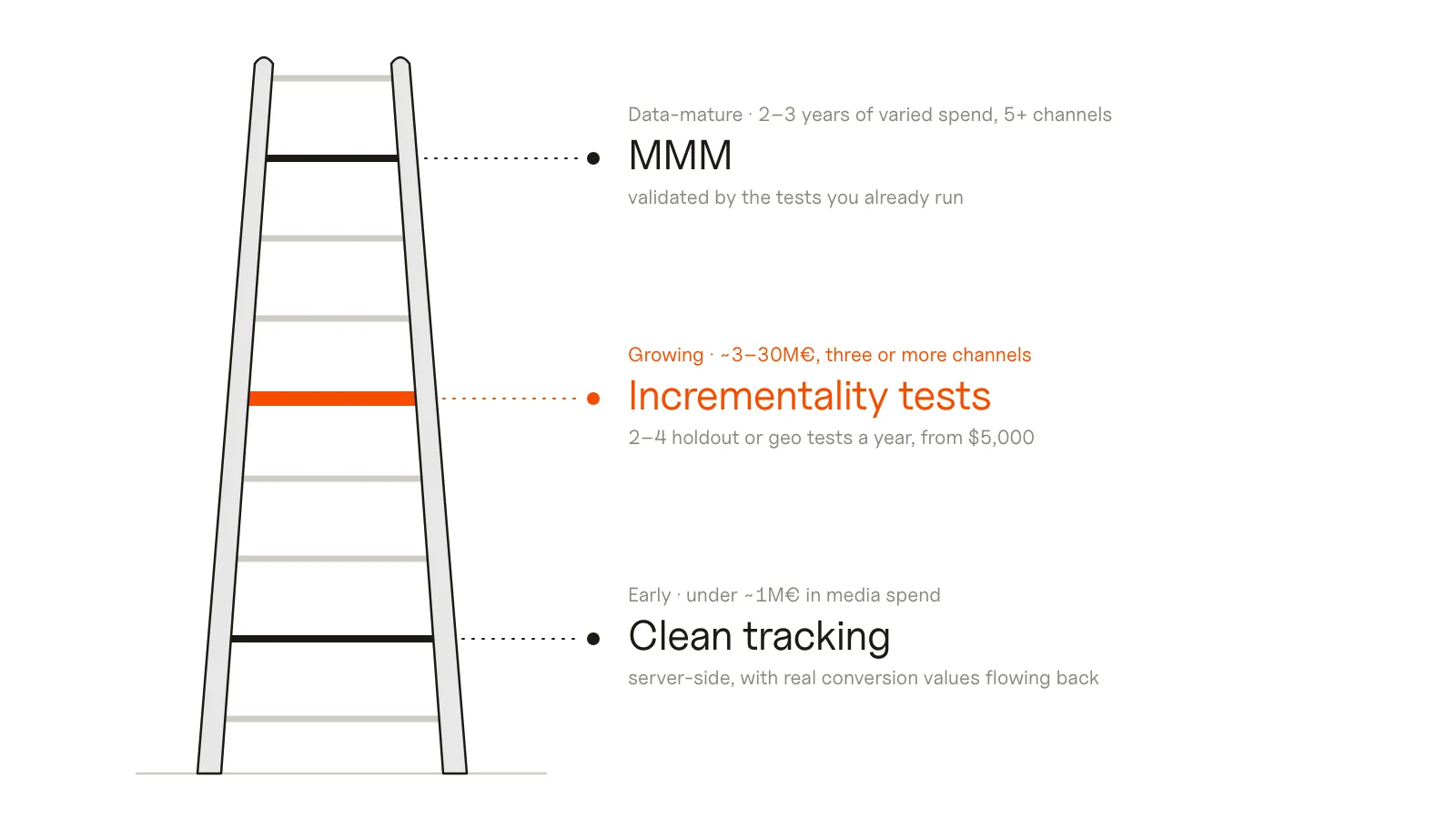
Early, under about 1 million € in media spend, on a handful of channels. Skip MMM and formal incrementality entirely. Get platform tracking clean: server-side, with real conversion values flowing back, not proxy events. Then read attribution with a pinch of salt. That is the whole job at this stage, and most brands here have not finished it. This is the work behind our Growth Audit, and it is where the majority of wasted spend quietly hides.
Growing, roughly 3 to 30 million €, spending across three or more channels. Incrementality is your on-ramp, and it finally got affordable. Google cut its lift-test minimum from roughly $100,000 to $5,000 in 2025, using a Bayesian methodology, and Meta open-sourced GeoLift, which measures at the market level with no user tracking. Two to four well-designed holdout or geo tests a year, on your biggest or most-uncertain channels, will teach you more than any dashboard. This is the mid-market sweet spot. Not MMM.
Data-mature, usually the upper end with real history behind it. Now you layer MMM, once you have two to three years of varied spend across five or more channels and someone who can actually run a Bayesian model. Validate it with the incrementality tests you are already running. Build it earlier and it becomes one of the least-trusted numbers you own.
The point
“Enterprise-grade measurement” was never really about budget. It is a discipline: clean inputs, causal tests on your riskiest bets, and no single dashboard treated as the final word.
That discipline is what I ran at GetYourGuide and Glovo, and it is the gap I built Farvero around. A mid-market brand that cannot yet hire a full data team still deserves measurement it can trust, matched honestly to what its stage can support. Enterprise-grade, without the enterprise overhead. If you want a second pair of eyes on where your measurement should start, that is a conversation I am happy to have, no pitch.
FAQ
What is Google Meridian?
Google Meridian is Google’s open-source marketing mix model. It is a Bayesian model, written in Python, that estimates each channel’s contribution to sales and ROI from aggregate weekly spend and outcome data, so it works without cookies or user-level tracking. It is free to use, and it can take the results of lift tests as priors, which is how you keep its estimates honest.
Google Meridian vs Robyn: which should I use?
Both are free and open-source. Robyn is Meta’s MMM, built in R, using ridge regression with automated hyperparameter search. Meridian is Google’s, built in Python and fully Bayesian, and it is designed to take experiment results as priors. The choice matters less than the inputs: either one needs two to three years of varied spend data and someone who can validate the output against incrementality tests.
How much data does an MMM actually need?
Roughly two to three years of weekly data with real spend variation across five or more channels. Google’s Meridian documentation treats two years against about 26 parameters as too little to estimate reliably. Below that, an MMM is data-starved and becomes one of the least-trusted numbers you have.
Is MMM only for big companies?
Not anymore, but not for the reason people assume. The models, Meridian and Robyn, are free. The gate is data maturity and statistical skill, not revenue. A brand can be doing 3M€ and still be years away from a reliable MMM, while a data-mature brand with varied spend history is ready earlier.
Where should a mid-market brand start?
Incrementality, not MMM. Google’s lift-test minimum dropped from roughly $100,000 to $5,000, and Meta open-sourced GeoLift. Two to four holdout or geo tests a year on your most important channels is a strong, affordable program.
Does incrementality testing need user-level tracking?
No. Geo-lift and holdout tests read aggregate outcomes at the market or group level. That is exactly why they survived ATT and cookie deprecation, and why measurement swung back toward them.
Can I trust platform attribution at all?
Yes, as a directional, in-flight optimization signal, not as truth. Last-click routinely over-credits branded search: holdouts often show 70 to 90% of those conversions would have happened anyway. Use it daily, but let incrementality settle the causal questions.
Key takeaways
- The models are free; running one well is not. Budget is no longer the barrier, skill and data are.
- Gate MMM on data maturity (two to three years of varied spend), never on revenue.
- Start mid-market measurement with incrementality, now accessible from $5,000 per test.
- Keep platform attribution for daily optimization, but treat it as directional.
- Run attribution, incrementality, and MMM together so they check each other. No single number is the truth.
Sources
- Google, Meridian is open to everyone
- Google, Meridian docs: amount of data needed
- Meta, Robyn (open-source MMM)
- eMarketer, Marketers double down on MMM and nearly half plan to invest in MMM
- TransUnion, confidence in measurement has stalled
- PPC Land, Google cuts incrementality testing to $5,000 minimum
- Search Engine Land, Bayesian testing: Google’s $5,000 incrementality and MMM tools explained
- MarTech, why measurement needs triangulation and time to move on from MTA